Penang's New Airbnb Rules (2026): Should Property Investors Be More Cautious — or More Interested?
The Real Question Behind Penang's 2026 STR Rules
A lot of discussion around Penang's new short-term rental rules starts with:
Is Airbnb still allowed?
For a property investor, I think that is the wrong starting point.
The better question is:
What exactly am I paying for when I buy an STR-oriented property after the new rules?
That distinction matters.
The usual STR investment story is simple: buy a unit, furnish it, appoint an operator, collect higher rental income than you would from a normal long-term tenant.
That can still work.
But in 2026, I would no longer underwrite Penang STR income based on casual assumptions such as:
- “Other owners here are already doing Airbnb.”
- “It has commercial title.”
- “The developer says short stay is allowed.”
- “There will be a professional operator.”
- “The project is Airbnb-friendly.”
Those statements may point you in the right direction. They are not enough to justify an investment decision.
My position is not anti-STR.
I actually think the new rules could eventually create better conditions for genuine STR properties if informal residential Airbnb supply is reduced.
But first, the project must prove that it belongs on the legal side of that divide.
The Misconception That Gets Buyers Into Trouble: “Commercial Title = Airbnb Allowed”
This is one of the most common shortcuts I hear in property sales.
“Commercial title, so Airbnb can.”
I would not accept that.
Commercial title may be relevant to whether a property can qualify for short-stay use. But it does not establish the entire right to operate STR.
Commercial title tells me how a property is classified. It does not tell me whether you can legally run Airbnb from it.
The Federal Court decision in Innab Salil & Ors v Verve Suites Mont' Kiara Management Corporation is useful here.
The dispute involved a commercially designated serviced-apartment development, yet the management corporation's rule restricting short-term rentals was upheld.
The practical lesson is important:
Even if the title or approved use looks favourable, strata-management rules still matter.
| Commercial title may be relevant to | Commercial title does NOT prove |
|---|---|
| Property classification | Local-authority STR eligibility |
| Potential commercial/hospitality use | Planning approval for STR |
| Whether an STR pathway may exist | JMB/MC permission |
| Licence application context | Exact unit eligibility |
| The project's positioning | A legal right to operate Airbnb |
So when somebody tells me:
“It's commercial title, Airbnb is okay.”
my next response would be:
Show me the rest of the permission chain.
What Actually Changed on 1 August 2026?
The major 2026 development is that Penang now has a formal local-authority licensing regime for private accommodation, or Tempat Inap Persendirian (TIP).
The by-law came into force on 1 August 2026.
The state subsequently announced a transition period before enforcement action from 1 November 2026.
These are two different dates:
- 1 August 2026: the by-law came into force.
- 1 November 2026: announced enforcement transition date.
The new framework matters because STR is increasingly being treated as a regulated operating activity rather than simply something an owner does with a condo.
The regime includes requirements involving:
- licensing;
- annual and administrative fees;
- guest records;
- safety and fire equipment;
- first-aid arrangements;
- nuisance controls;
- council investigation powers;
- suspension and revocation;
- closure powers; and
- penalties for non-compliance.
My interpretation is that Penang is not attempting to eliminate all STR.
It is trying to distinguish controlled, accountable private accommodation from casual informal operation.
And that distinction could become economically important for property investors.
| Question | Earlier 2023 framework | 2026 position |
|---|---|---|
| Basic approach | Administrative framework for private accommodation | Formal local-authority by-law and licensing regime |
| Timing often quoted | Earlier discussions commonly referenced 180 days/year and three days/week | By-law in force from 1 August 2026, with enforcement transition announced until 1 November 2026 |
| Buyer takeaway | Historical reference point | Check current licence, planning and building conditions for the exact property |
The Five Permission Layers You Need to Check
A serious STR investment needs more than one “yes.”
I would break the decision into five layers.
| Layer | What needs to be proven |
|---|---|
| 1. Local-authority licence | Can the property/operator qualify under MBPP or MBSP requirements? |
| 2. Planning / approved use | Does the property's approved use support the proposed STR activity? |
| 3. JMB / MC / DMC rules | Does the building actually permit transient stays? |
| 4. Operator structure | Who operates it, under what agreement, and who carries the licence/compliance obligations? |
| 5. Exact unit eligibility | Does the permission actually apply to this parcel/unit and to a future buyer? |
These layers are cumulative.
A council licence does not necessarily cancel a building restriction.
Likewise, a JMB or MC allowing Airbnb does not legalise an operation that fails local-authority or planning requirements.
Instead of asking:
“Can this project Airbnb?”
ask:
“Can this exact unit pass every permission layer?”
If one of those answers relies entirely on a salesperson's verbal assurance, I would treat the projected STR income as speculative.
Penang Island vs Seberang Perai: Two Different Realities
Penang should not be treated as one uniform STR jurisdiction.
| Area | Local authority | Current investment reality |
|---|---|---|
| Penang Island | MBPP | Ordinary residential strata is materially restricted for TIP. Certain serviced, commercial or hospitality-oriented categories may have a pathway, subject to the other approval layers. |
| Seberang Perai | MBSP | Historically broader in principle, including residential and commercial categories subject to conditions. Post-2026 project-specific procedures still need verification. |
Penang Island — MBPP
The current MBPP position is materially stricter toward ordinary residential strata.
Residential strata properties are stated to be ineligible for TIP operation, while certain commercial categories such as serviced apartments and SOHO may potentially be considered subject to the relevant planning, licensing and building requirements.
That does not mean every serviced apartment or commercially titled development is automatically suitable for Airbnb.
It means some products may have a pathway that conventional residential strata do not.
And that pathway still has to be proven.
Seberang Perai — MBSP
The historical MBSP position has been broader, including potential TIP operation across residential and commercial categories subject to conditions.
However, the detailed post-2026 pathway still needs project-specific verification.
That creates a different risk.
Penang Island may be stricter.
Seberang Perai may appear more permissive.
But:
More permissive does not automatically mean safer if the precise approval process is still unclear.
The correct answer always comes back to the exact property.
What About the Famous 180-Day Airbnb Limit?
Many Penang STR discussions still repeat:
180 days per year and three days per week.
Those restrictions came from the earlier 2023 framework.
But the 2026 by-law itself does not clearly reproduce a universal 180-day annual cap in the way it is commonly repeated online.
That does not mean I would immediately assume every eligible STR property can operate freely for 365 days.
There can still be restrictions arising from:
- licence conditions;
- planning approvals;
- JMB/MC rules;
- building operating policies; or
- project-specific requirements.
So I would avoid both extremes.
I would not tell a buyer:
“Penang Airbnb is definitely limited to 180 days.”
And I would not tell them:
“The old rule is gone, so you can definitely operate 365 days.”
The correct question is:
What do the current approvals and rules say for this exact property?
Until that is proven, don't underwrite 365 days of operating availability.
Why Regulation Could Eventually Favour Compliant STR
This is where I am more positive than some buyers may expect.
Tighter regulation does not automatically make STR a worse investment.
There is a possible opposite effect.
Imagine ordinary residential Airbnb becomes increasingly difficult to operate legally.
That raises the barrier to entry.
If genuinely compliant STR supply remains limited while tourism demand remains healthy, then properties that can legally continue operating short stays may gain an advantage.
The basic logic is:
Informal supply reduces → barriers to entry increase → compliant supply becomes relatively scarcer → legal STR eligibility potentially becomes more valuable.
If two properties are competing for the same short-stay guest, but one can legally continue operating while the other cannot, that permission has economic value.
That is my thesis.
But it is important to separate a plausible mechanism from a proven market outcome.
As of September 2026, we do not yet have evidence showing that compliant properties are already achieving higher occupancy, ADR, net returns or resale prices because of the new rules.
Henry's Take: STR remains a rational investment strategy to consider. Regulation could eventually give genuinely compliant supply an advantage. But the next step is to try to disprove that thesis—not fall in love with it.
Stress-Testing the Thesis
The adversarial research conclusion was:
Too early to rely on.
I think that is correct.
What survives
- Licensing is now formalised.
- Enforcement powers exist.
- Ordinary Penang Island residential STR faces greater constraints.
- Properly compliant projects may have a clearer legal pathway.
- Meaningful enforcement could reduce informal competition.
What does not survive yet
We cannot currently prove that:
- actual Airbnb supply has materially fallen;
- compliant operators are achieving higher ADR;
- compliant units are achieving higher occupancy;
- strong Penang tourism guarantees STR profitability;
- STR permission is permanent;
- “Airbnb-friendly” projects deserve a valuation premium; or
- projected high STR income automatically compensates for a weak fallback use.
The mechanism survives. The market outcome does not yet.
That is a very different thing from saying the STR thesis is wrong.
It means a buyer should not pay today as though the future benefit has already been proven.
The Supply Substitution Problem
This is the biggest challenge to the scarcity thesis.
Suppose enforcement succeeds and ordinary residential Airbnb supply declines.
At the same time:
- new serviced apartments enter the market;
- more projects adopt managed STR models;
- branded residences compete for the same guest;
- hotel supply increases.
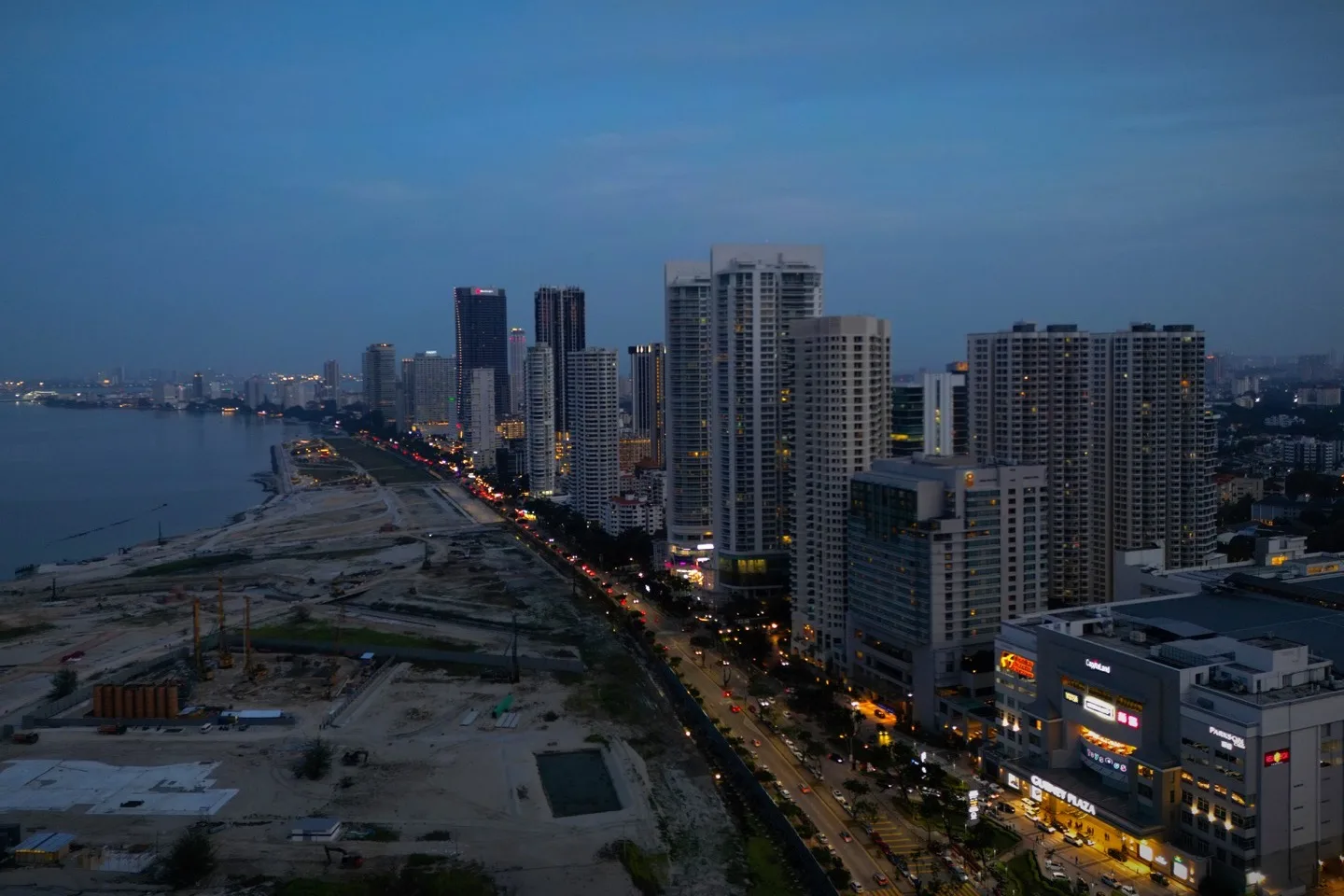
Large mixed developments such as The Light City also matter here, because regulation can reduce informal Airbnb competition while new hotel, serviced-residence and investor-oriented stock in areas like this keeps entering the market.
Then the market may not become scarce at all.
It may simply change from:
informal residential Airbnb
to:
formal serviced apartments + managed STR + hotels.
That is supply substitution.
And it matters because removing one category of accommodation does not automatically reduce the total number of rooms competing for tourist demand.
A family visiting Penang may compare an Airbnb with a serviced residence.
A business traveller may compare a managed apartment with a hotel.
A couple may simply choose the better-priced accommodation regardless of whether it is labelled STR or hotel.
Do not state that Penang already has proven legal STR oversupply.
Before paying a premium for STR scarcity, first prove that real scarcity exists.
Is Legal STR a Regulatory Moat?
Not yet.
I would call it a potential temporary regulatory advantage.
That matters because:
- licences expire and require continuing compliance;
- licences are not permanent property rights;
- licence is not automatically transferable;
- JMB/MC rules can change;
- policy can tighten;
- operator arrangements can fail; and
- competing legal supply can be created.
Let the market prove the advantage first.
The Number That Actually Matters: Net Income
STR gross booking revenue is not owner income.
| STR item | What the buyer should ask |
|---|---|
| Gross bookings | Actual results or projection? |
| Operator/platform fees | What percentage and charged on what base? |
| Cleaning/laundry | Who pays? |
| Utilities/service charges | Included in the model? |
| Licence/TIP fees | Included annually? |
| Repairs/furnishing | Is there a reserve? |
| Vacancy/discounting | Has low season been modelled? |
| Tax/financing | Included in investor return? |
| Downtime | What happens during licence/operator interruption? |
The question is not how much Airbnb collects. It is how much money reaches the owner's pocket after everything else.
Compare:
net STR owner income
against:
net LTR owner income.
Do not compare gross STR bookings against ordinary monthly rent.
The Price-Premium Test
Here is a simple illustration.
| Project A | Project B | |
|---|---|---|
| Positioning | STR-capable | Conventional |
| Price | RM1,300 psf | RM1,050 psf |
This is an illustration, not market pricing.
Project A is approximately 23.8% more expensive per square foot.
Therefore it needs approximately 23.8% more net income merely to achieve yield parity.
That does not yet compensate for:
- regulatory dependency;
- operator risk;
- tourism volatility;
- possible licence interruption; or
- potentially narrower resale liquidity.
The more you pay for STR eligibility, the harder the STR income has to work.
Comparing a Penang property that claims to be STR-friendly?
Send me the project or unit you’re considering. I can help you check the permission chain, the STR operating model and whether the extra price you’re paying is actually supported by the numbers.
Check This PropertyDoes Every STR Property Need a Strong LTR Fallback?
The conventional argument is that a strong long-term-rental fallback protects the investor if the STR plan stops working.
That fallback can matter if:
- a licence is lost;
- JMB or MC rules change;
- the operator performs poorly;
- tourism demand weakens; or
- policy changes again.
I understand that argument.
But I would not make it an absolute rule.
A specialised STR property can make sense even if its LTR return is weak.
But only when:
- legal eligibility is strong;
- entry price makes sense;
- actual net STR income is sufficiently attractive;
- operator risk is understood; and
- buyer accepts volatility.
The dangerous combination is high purchase premium + weak LTR fallback + unproven STR income.
Henry's Take: Weak LTR fallback alone does not kill an STR investment. But high entry price + weak fallback + unproven STR income is a combination I would avoid.
Don't Confuse the Property With the Operator
A managed STR property is:
real estate + operating business
The real estate gives you the physical unit and location.
The operating business determines how that unit is priced, marketed, cleaned, reviewed and managed.
That means the operator affects:
- fee waterfall;
- contract period;
- termination rights;
- exclusivity;
- listing-account ownership;
- operator replacement;
- owner-use restrictions;
- furnishing obligations; and
- guarantee terms, where claimed.
A professional operator can improve execution.
It cannot remove every investment risk.
If somebody uses the word “guaranteed”, read the guarantee—not the brochure headline.
Do not underwrite an STR property without understanding what happens if the operator underperforms, exits the project or is replaced.
Before Paying for “STR-Friendly”, Verify These Four Areas
I would group the due diligence into four practical areas.
| Area | Documents or evidence to check |
|---|---|
| Legal / Planning | Exact title and approved use; MBPP/MBSP jurisdiction; written eligibility; licence pathway and conditions; whether a future buyer can obtain the relevant licence |
| Building / Strata | DMC and house rules; JMB/MC STR position; valid resolution where required; guest-access requirements; STR fees or deposits; amendment or reversal risk |
| Operator | Full agreement; fee waterfall; track record; termination and replacement rights; listing-account control; guarantee terms if claimed |
| Investment Economics | Actual comparable STR performance; owner net remittance; independent purchase-price comparables; downside occupancy/ADR; LTR fallback; resale buyer pool |
Legal / Planning
Ask for the exact title and approved use, the MBPP or MBSP jurisdiction, written eligibility, the licence pathway and conditions, and whether a future buyer can obtain the relevant licence.
Building / Strata
Ask for the DMC, house rules, JMB or MC STR position, valid resolution where required, guest-access requirements, STR fees or deposits, and amendment or reversal risk.
Operator
Ask for the full agreement, fee waterfall, track record, termination or replacement rights, listing-account control, and guarantee terms if claimed.
Investment Economics
Ask for actual comparable STR performance, owner net remittance, independent purchase-price comparables, downside occupancy and ADR, LTR fallback, and resale buyer-pool analysis.
If the evidence is not there, I would not pay for the STR story today.
Five Conditions for the STR Thesis to Work
These are the conditions for the market thesis, not just the property-level document checklist.
- Enforcement actually reduces informal competing supply.
- The exact project has durable legal eligibility.
- JMB/MC permission remains stable.
- Verified net STR income materially outperforms alternatives.
- The buyer does not overpay.
Only two of the five are regulatory.
The rest are economics and execution.
Five Signs That Would Break the Thesis
Because the 2026 regulation is new, this view should be updated when actual evidence emerges after the enforcement transition.
| What strengthens the thesis | What weakens it |
|---|---|
| Informal STR inventory falls | Listing inventory remains high |
| Licensed units gain sustainable occupancy/ADR/net income | Compliant units show no meaningful improvement |
| Licensing becomes clear and workable | Licensing proves inconsistent or restrictive |
| Legal accommodation supply remains disciplined | STR/hotel/service-apartment supply grows faster than demand |
| Resale buyers value proven STR economics | STR-oriented units show weak liquidity or require higher yields |
The regulation may create winners. As of September 2026, we do not yet know who they are.
Decision Framework: Should You Buy a Penang STR Property Today?
This is how I would run the decision, gate by gate.
Gate 1 — Which local authority?
Penang Island or Seberang Perai?
Gate 2 — Can the exact unit pass every permission layer?
If no, do not underwrite STR income.
Gate 3 — What is realistic net STR owner income?
Ignore gross booking screenshots unless they reconcile to owner net remittance.
Gate 4 — How does the income compare with the purchase price?
The higher the price, the more convincing the net income needs to be.
Gate 5 — What premium are you paying specifically for STR eligibility?
If the premium is large, the STR advantage must be proven, not assumed.
Gate 6 — If LTR fallback is weak, are you being compensated enough?
Weak fallback is not automatically fatal, but the verified STR economics must compensate for the narrower exit route.
Gate 7 — Can you tolerate operator, tourism, regulatory and resale volatility?
If all seven gates pass, STR can be treated as a legitimate specialised investment strategy.
If several depend on marketing assumptions or future promises, do not underwrite the property as STR.
Henry's Bottom Line
Penang's 2026 STR rules do not make me automatically bearish on Airbnb-focused property.
Tighter regulation could eventually create an advantage for properties that can genuinely continue operating STR while informal residential competition becomes harder.
But we do not yet know whether that advantage will become real market scarcity.
And we do not yet know whether compliant properties will earn enough additional net income to justify the premium investors may be asked to pay.
So my position is:
Treat STR income as speculative until the exact unit/building has documented council and management approval.
Pay for verified net cash flow—not for the words “Airbnb-friendly.”
Comparing Penang properties where STR is part of the investment case?
I can help you test the project using the same legal-permission, net-income and price-premium framework before you decide.
Sources
- Private Accommodation (Penang State Local Authority) By-Laws 2026 - Commencement, licensing, fees, operator obligations, enforcement powers, suspension, revocation, licence duration and non-transferability. (as of 8 Sep 2026)
- Penang State Government / Buletin Mutiara — August 2026 TIP implementation announcement - Transition and enforcement date, MBPP versus MBSP implementation position, property-category statements and enforcement context. (as of 8 Sep 2026)
- MBPP Planning Guideline for Private Accommodation / TIP - Penang Island planning and property eligibility for private-accommodation operation. (as of 8 Sep 2026)
- MBSP Private-Accommodation / TIP Guideline - Mainland private-accommodation framework and jurisdictional distinction between MBSP and MBPP. (as of 8 Sep 2026)
- Federal Court — Innab Salil & Ors v Verve Suites Mont' Kiara Management Corporation - Strata-management authority to restrict short-term rental use despite serviced-apartment commercial context. (as of 8 Sep 2026)