Andaman Island vs The Light City: Future Demand or Future Premium?
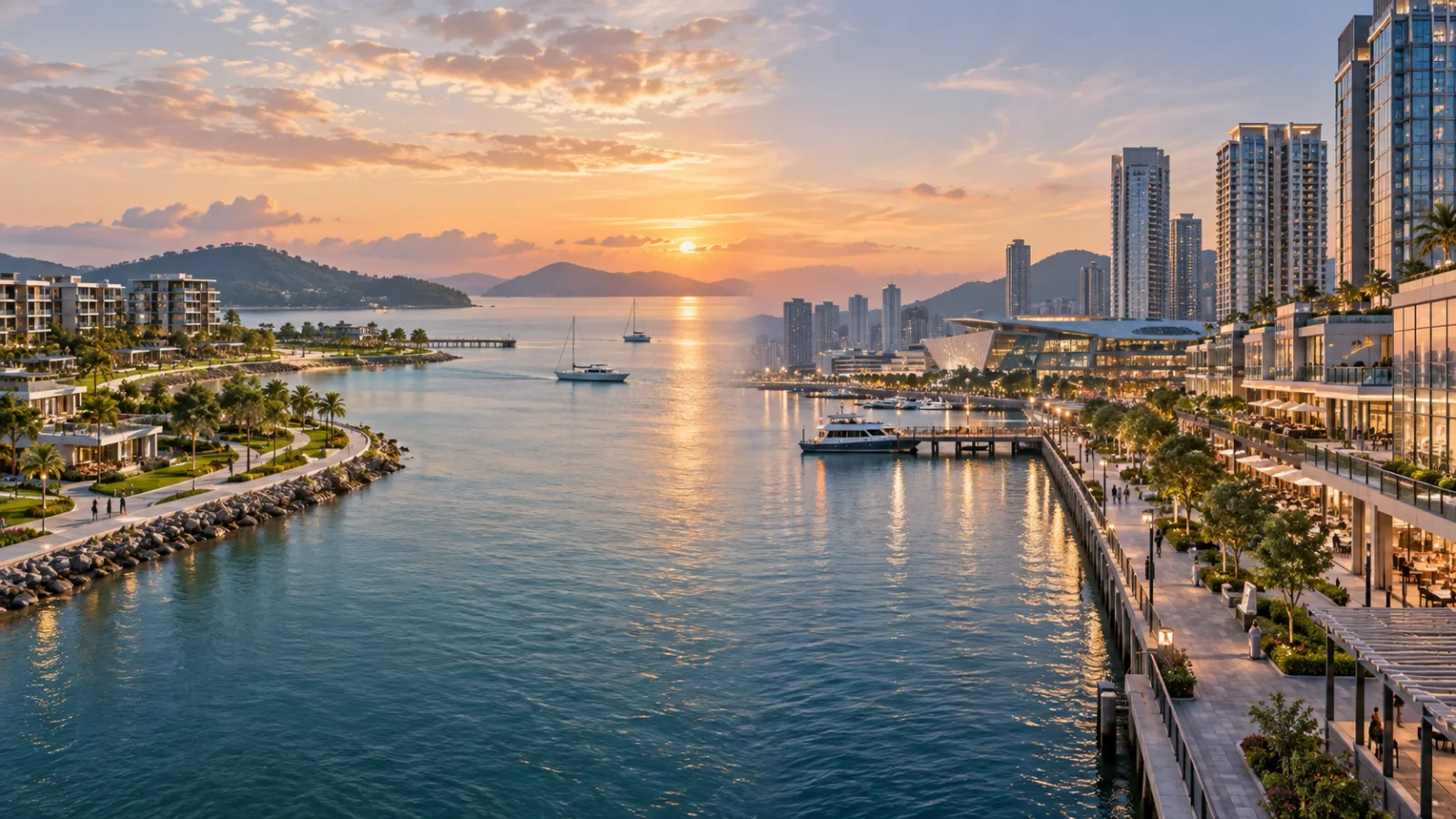
Andaman Island and The Light City are often mentioned in the same breath. Both are large-scale Penang waterfront developments. Both mix residential towers with retail, hospitality and lifestyle components. Both are marketed as long-term destinations rather than single condominium launches.
But they are not two versions of the same bet.
What Are You Actually Buying?
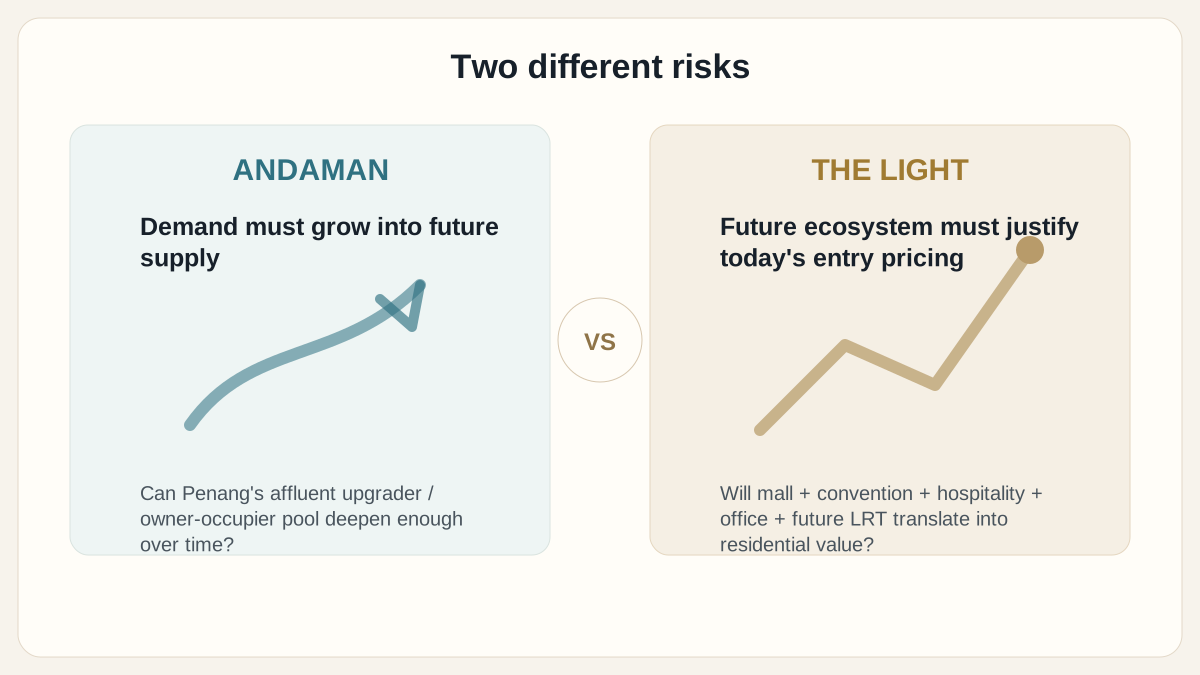
Andaman is still a work in progress. Large parts of the masterplan — including much of its high-rise residential stock — are yet to be built or only recently completed. What a buyer is purchasing today is largely a residential ecosystem that is still forming, backed by a developer with a long township track record in the area.
The Light City is further along in visible delivery, but it is not a single, uniform product. It's home to several different residential projects, at different price points, from more than one developer — a distinction that matters more than the old headline comparison suggested, and one this article treats properly below.
Andaman's Real Question: Can Demand Grow Into the Supply?
Andaman's masterplan implies a long runway of future launches — reportedly in the order of a billion ringgit of new residential supply per year over the coming years. On its own, that number tells you very little. Supply is only a problem if demand doesn't keep pace with it. The real question is whether it will — and whether a successful township can lift multiple phases together as real demand deepens, rather than simply flooding the market with competing stock.
There are reasons to take the bullish case seriously. At Arica, one of Andaman's early launches, E&O reported that 97% of buyers were Penang residents, with only 3% foreign buyers. Management said this buyer profile led it to expect a high degree of owner occupancy. That's encouraging, but it needs to be read carefully: the figure is specific to Arica, not the entire Andaman pipeline, and the owner-occupancy point is a management expectation rather than an independently measured outcome.
Recent phases have also shown meaningful take-up at launch, which is a genuine positive sign. But take-up at launch is a short-term indicator. It tells you units sold; it doesn't yet tell you whether that demand will still be there — for both rental and resale — several launches from now, as more supply keeps entering the market. The question that actually decides the outcome is simpler than "too much supply": will Penang's pool of affluent, upgrade-minded buyers grow deep enough, fast enough, to keep absorbing what's coming?
Why STP1 Gives Andaman Some Credibility — But Not Proof
Andaman is not E&O's first attempt at large-scale waterfront township development in this location. Seri Tanjung Pinang's first phase (STP1) reportedly saw its landed housing stock appreciate strongly over roughly a decade — a track record that gives Andaman's bull case some real historical weight. A successful township, this precedent suggests, can lift value across its own later phases rather than simply competing with them for the same pool of buyers.
That said, this evidence shouldn't be stretched further than it can bear. STP1's strongest results were concentrated in landed housing, developed under different market conditions, over a much longer runway than current buyers are being asked to evaluate. Andaman's current generation of product is high-rise-led. A track record built on landed homes a decade or more ago is a reasonable point in Andaman's favour — it is not a direct test of how today's condominium towers will perform.
The Meg: Andaman's First Real High-Rise Test
If STP1 is Andaman's best historical evidence, The Meg is its most important current one — and this is where the bullish case runs into its clearest gap.
Asking prices for The Meg suggest only modest appreciation since launch. That's useful context, but it isn't the same as transacted price movement. PropertyGuru's market-insight panel recorded zero sale transactions in the 12 months to August 2026, which reinforces how limited the project's publicly visible secondary-market evidence remains.
A notable share of The Meg's units currently appear listed for sale or rent. It's tempting to read this as a liquidity problem, but that doesn't follow automatically — a high volume of listings can reflect genuine oversupply, active investor churn, or simply a large project reaching a point where many owners test the market at once. Without transaction counts to compare against listing counts, it isn't possible to say which of these is happening. Asking rents follow the same pattern — they hint at a rental narrative but aren't backed by achieved-rent or tenant-profile data.
Put together: a credible township story, resting on real historical precedent and a currently reassuring (if developer-reported) buyer profile — but without yet having built a strong, transaction-verified resale or rental track record of its own.
The Light's Bigger Bet: Can It Become Penang's Third Major Destination?
It's easy to describe The Light as an LRT story, but that undersells what's actually being attempted. Penang currently has two well-established retail and lifestyle destinations: the Gurney cluster to the north, and Queensbay to the south. The Light's real proposition is whether it can become a third — a genuine central, bridge-adjacent destination rather than a secondary residential address.
Its case rests on several components layered together: Waterfront Shoppes, a planned convention centre, an office component, hospitality, its waterfront position, and eventually an LRT connection with improved central accessibility.
Waterfront Shoppes is the nearest-term test of this idea. It has a confirmed opening date in late 2026 and meaningful physical scale — large enough that it could plausibly change how the area functions day to day. But as of now, it has no operating track record. Confirmed and large isn't the same as proven.
What Could the LRT Actually Change?
The future Mutiara Line LRT deserves a more specific discussion than "transit is coming." The most defensible way to think about its potential impact isn't as a guaranteed price driver — it's as a catchment-expansion story.
If it delivers, the LRT should make The Light easier to reach without a car, which matters for concrete reasons: a bigger radius of prospective tenants who currently rule the area out over commute time; a bigger pool of resale buyers who aren't reliant on driving; and better practical connection to other employment and commercial nodes around Penang. That's accessibility widening the buyer and tenant pool — not a mall or a tower doing it alone.
What the current evidence doesn't show is any of that already happening. Transaction data from The Light Point and Waterside doesn't show a clear premium or price acceleration attributable to LRT planning or construction so far. That's consistent with the timeline: the LRT is a longer-dated catalyst, still years from operation, while Waterfront Shoppes is a near-term, testable one. They test different things. The mall tests whether people have a reason to come to The Light. The LRT tests whether more people can reach it easily once they do.
For now, the LRT remains a future catalyst rather than a demonstrated current driver of appreciation — which matters directly for how much a buyer should be paying today for connectivity that hasn't been priced by the market yet.
What Queensbay Actually Teaches Us
Queensbay is the most useful comparison available, and it deserves a more careful reading than "the mall drove appreciation."
Q1 Queens Residence, the residential tower most closely associated with Queensbay Mall, has genuinely appreciated based on actual transaction evidence. But the sequencing matters: Queensbay Mall had already been operating and maturing as a destination for roughly a decade before Q1 launched. The mall wasn't a new catalyst working alongside Q1 — it was already an established fixture of the area.
That changes the lesson. Bayan Lepas didn't succeed because a mall opened nearby. It succeeded because several things were layered on top of each other: the Free Industrial Zone and its multinational employment base, an already-mature residential catchment, an established retail destination, decent accessibility, and a broader property market recovery happening at the same time. No single factor was doing all the work.
The Light doesn't currently have a direct equivalent to Bayan Lepas's FIZ-scale employment base. That's a real structural difference. It doesn't mean The Light's thesis fails — it means The Light is attempting a different demand model: retail, convention traffic, hospitality, office space, and eventually transit-driven accessibility, rather than industrial employment. Whether that combination can do the job employment did for Queensbay is the central open question behind The Light's residential case.
The Light Is Not One Residential Product
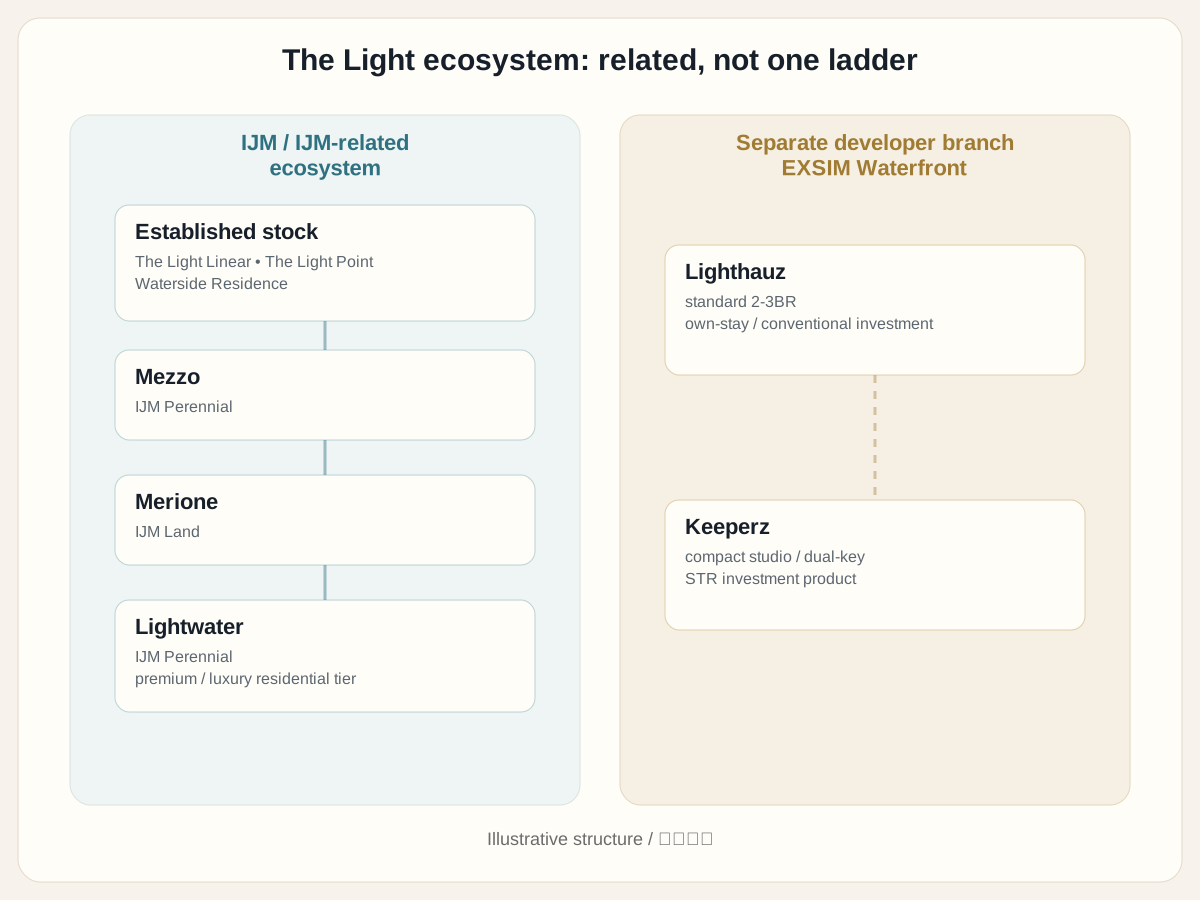
Before going further, it's worth correcting a simplification the comparison has been carrying: The Light isn't one developer running one product ladder. It's a precinct with at least two distinct branches, and treating them as a single story blurs the buyer decision.
The first branch sits with IJM. The older, established stock — The Light Linear, The Light Point, Waterside Residence — has been around long enough to have real transaction histories. More recently, IJM Perennial has added Mezzo, completed in 2025, and Lightwater, its larger premium product. Merione sits in between numerically, but it's identified as an IJM Land product rather than sitting under the same IJM Perennial entity as Mezzo and Lightwater. These projects form a partial pricing and product ladder within the broader IJM-led ecosystem, though they don't all sit under exactly the same development entity or building format — related, rather than one deliberately engineered sequence.
The second branch belongs to a different developer entirely. Lighthauz and Keeperz are built by EXSIM Waterfront Sdn Bhd — geographically part of the broader Light Waterfront story, but structurally separate products.
That separation matters most for Keeperz. It's a compact, studio/dual-key format, and it's best understood as a short-term-rental-oriented investment product rather than a conventional residential rental unit. Its economics depend on occupancy, achievable daily rates, operating and management costs, and the strength of whichever operator model is in place — not on ordinary monthly tenancy. That's a different lens from how you'd evaluate Mezzo, Merione, Lightwater or even Lighthauz.
Where the Pricing Really Starts to Stretch
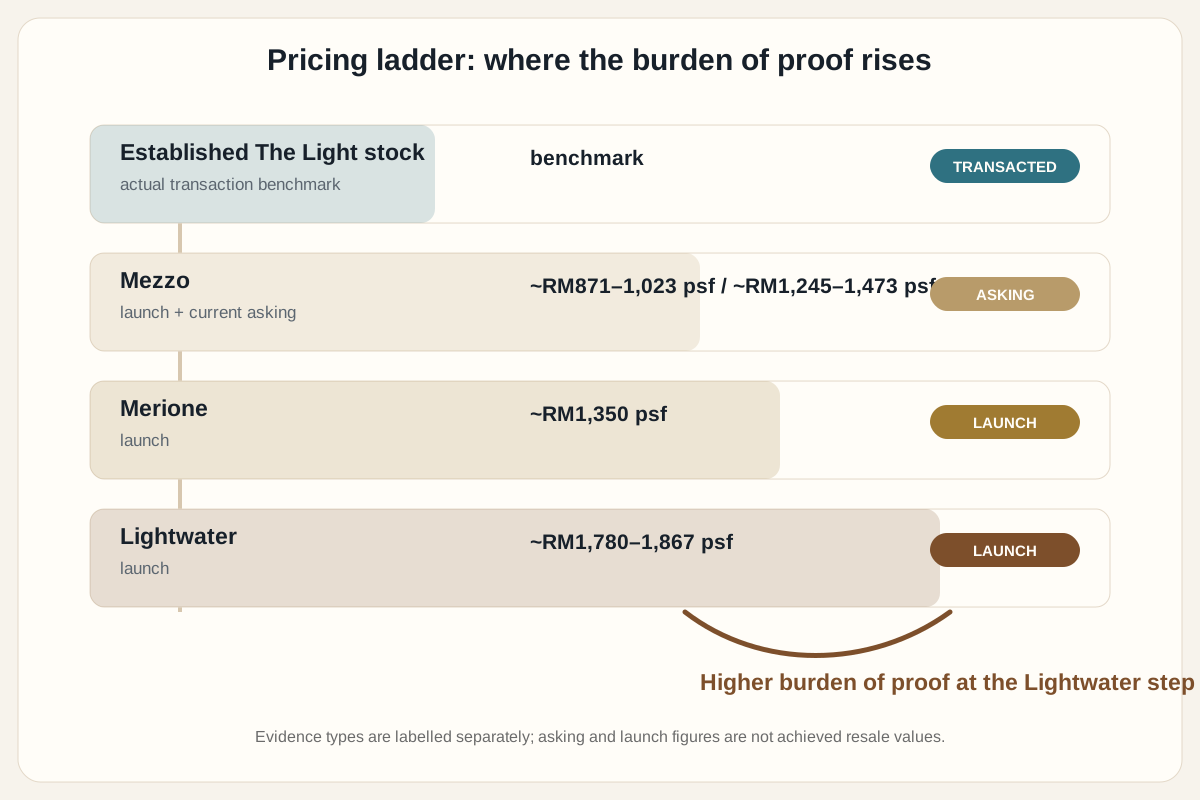
Once you separate the branches, the pricing story becomes more precise than "every new launch at The Light is expensive."
| Project | Developer | Size | Price / PSF basis | Positioning |
|---|---|---|---|---|
| Established stock — The Light Point / Waterside / The Light Linear | IJM | Established stock | Actual transacted benchmarks | Own-stay / mixed investor; established resale evidence |
| Mezzo | IJM Perennial | ~1,033–1,367 sqft | Launch ~RM871–1,023 psf; current asking ~RM1,245–1,473 psf — asking, not transacted | Affluent own-stay / family upgrader |
| Merione | IJM Land | ~1,054–1,259 sqft | ~RM1.424m+; ~RM1,350 psf launch | Mid-premium family upgrader; 3BR only |
| Lightwater | IJM Perennial | ~1,152 sqft+ | ~RM2.06m+; ~RM1,780–1,867 psf launch | Premium / luxury / larger-family lifestyle |
| Lighthauz | EXSIM | ~732–1,001 sqft | ~RM865K–1.4m | Young professional / couple / small family; mixed own-stay and conventional investment |
| Keeperz | EXSIM | ~484–581 sqft | ~RM820K+ | STR / short-term-rental investment |
Read this progression carefully, because it's more useful than treating Lightwater as an isolated outlier. Mezzo's original launch pricing represented a relatively gradual, market-consistent step up from the established stock around it. Merione, at roughly RM1,350 psf, lands within Mezzo's current asking range and provides another intermediate rung — a newer launch that hasn't made an extreme leap. The pricing progression looks relatively rational through Mezzo and arguably Merione. It becomes much more demanding specifically at Lightwater, which sits roughly 32–50% above Merione on a per-square-foot basis.
That doesn't mean Lightwater's premium is unjustified on its face. It genuinely occupies a different tier — larger units, premium positioning, residential title, a more affluent and lifestyle-oriented buyer than either Merione or the EXSIM projects. The real question is what exactly Lightwater must deliver — in destination maturity, connectivity and finished product — to justify the final step beyond what Merione already demonstrates is a reasonable intermediate price. Lightwater is not expensive simply because it launched later; Merione shows a newer product can enter at a gradual step-up. The sharper jump is specific to Lightwater.
Two caveats keep this honest. Mezzo's current figures are asking prices, not a verified transaction series. And Merione is itself an uncompleted new launch, so neither project proves the secondary market has validated RM1,300-plus psf pricing at The Light. What they do show is that the path to Lightwater's price point wasn't a single leap — which sharpens, rather than answers, the question of what Lightwater's buyers are paying for.
Lighthauz and Keeperz sit in a different budget bracket but overlap financially with each other, even though they don't overlap in use case. A roughly RM850K–900K buyer could plausibly compare the two on price alone, but Keeperz is an income/STR-led purchase while Lighthauz is a standard 2–3-bedroom unit suited to own-stay or conventional investment — a budget overlap with differentiated use cases, not the kind of direct product cannibalisation you'd expect from two comparable units competing for the same buyer.
It's also worth naming the structural difference this creates for supply risk. Andaman's question is whether one master developer can keep deepening genuine demand while releasing a large, multi-decade pipeline of broadly similar high-rise product. The Light's question is different in shape: whether several projects, product types and developers — IJM's ladder and EXSIM's separate branch — can each keep attracting their own distinct buyer pools while progressively higher new-launch pricing is introduced around the same destination narrative. Neither structure is automatically safer than the other; they're different kinds of demand-matching problems.
Rental: The Most Important Question — And the Least Proven
Rental sits at the top of AskHenry's decision hierarchy, which makes it worth stating plainly: for conventional residential rental, the evidence remains thin across both masterplans.
Andaman's rental case would likely depend on lifestyle-driven tenants — affluent local renters, professionals, and possibly expatriates drawn by the township's amenities as they mature. The Light's conventional rental case (Mezzo, Merione, Lightwater, Lighthauz, and the established stock) would likely depend on office activity, the mall, convention traffic, and eventually the LRT. Both stories are plausible; neither is currently backed by verified achieved-rent data or a clear tenant profile.
Keeperz is a separate case, because it isn't positioned around ordinary tenancy at all. Its returns depend on occupancy, achievable daily rates and operating structure — a short-term-rental business model rather than a conventional rental one. That doesn't make it inherently better or worse; it makes it a different question, and one this article isn't attempting to underwrite with specific yield figures that aren't yet verified.
If rental is your first priority, this evidence gap should lower your confidence across the board rather than push you toward whichever advertised yield looks highest.
Resale Liquidity: Historical Proof vs Current Proof
Andaman has stronger historical township precedent, largely through STP1's landed track record. The Light has stronger proof specifically in its established stock — The Light Point and Waterside both have real transaction histories, even if that history shows near-flat or range-bound pricing rather than strong compounding.
The Light's post-2021 generation doesn't yet carry the same weight. Mezzo has only limited, largely asking-price evidence available. Merione and Lightwater aren't completed or market-tested yet. So the resale liquidity that The Light can genuinely point to belongs mostly to its older stock — it isn't a property the newer launches have earned for themselves yet.
Andaman, meanwhile, has the reverse gap: strong historical upside precedent, but its current high-rise generation, led by The Meg, hasn't yet built equivalent transaction-level proof of its own.
Which Buyer Fits Which?
- Long-horizon, township-believer, own-stay or lifestyle-led → Andaman lean.
- Lower execution-risk tolerance, wants completed resale evidence → established The Light resale stock (The Light Point, Waterside) lean.
- RM800K–900K, income/short-term-rental-focused investor → Keeperz becomes relevant, but assess it as an STR business/income product, not conventional residential rental.
- RM850K–1.4m, wants a standard 2–3BR unit → Lighthauz is more directly relevant than Keeperz.
- RM1.3m–1.6m family or upgrader → Mezzo vs Merione becomes the more meaningful comparison within The Light.
- RM2m+ premium family or lifestyle buyer → Lightwater becomes relevant, but its entry price carries the highest burden of proof in this entire comparison.
- Rental-first conventional investor → no clear winner based on achieved-rent evidence.
- Resale-liquidity-first buyer → established The Light stock currently has the stronger documented proof.
Sources
- Arica buyer profile and E&O owner-occupancy expectation - Reputable media reporting E&O management. The 97% Penang-resident / 3% foreign split is specific to Arica, one early Andaman launch — not the whole Andaman pipeline. High owner occupancy is a management expectation, not an independently measured outcome.
- STP1 landed historical appreciation precedent - Reputable media carrying analyst research (AmResearch). Reported STP1 terraced homes launched around RM600,000 in 2005 and last transacted around RM2.2m by February 2014. Landed terraced housing and historical — not a like-for-like precedent for current Andaman high-rise product.
- The Meg official APDL project details - Official developer/APDL disclosure: Persada Mentari Sdn Bhd (E&O subsidiary), 1,020 units, freehold, service apartment, official selling price RM543,400–RM1,190,900.
- The Meg sale asking evidence and limited transaction profile - Portal listing and market-insight evidence: 115 active sale listings as at August 2026. Listing prices are ASKING prices, and listings are not transactions. The zero-transaction figure is PropertyGuru platform-recorded market insight, not a complete JPPH/NAPIC transaction census.
- The Meg rental asking evidence - Portal listing evidence: 300+ active rental listings with asking-rent examples. Asking rent only — not achieved or signed tenancy. Listing count alone does not prove rental demand is weak or strong.
- IJM Land — The Light Waterfront (official project site) - The Light City masterplan components: retail, convention centre, hospitality, office, waterfront positioning.
- IJM Corporation — 4QFY26 Company Briefing (PDF) - Developer-entity structure and The Light Waterfront pipeline as reported by IJM.
- IJM Land — Merione (official project page) - Merione as an IJM Land product; unit sizes and 3BR-only configuration.
- IJM Land — Lightwater Residences, Redefining Waterfront Living in Penang - Lightwater positioning as a larger premium residential tier under IJM Perennial.
- EXSIM — Keeperz Suites (official project page) - Keeperz as an EXSIM Waterfront product; compact studio/dual-key format underpinning the short-term-rental orientation.
- Lighthauz (official project site) - Lighthauz as an EXSIM Waterfront product; 2BR/3BR sizes and conventional residential use case.
- EdgeProp Malaysia — Merione new-launch listing - Merione launch pricing and unit-size range used in the pricing-ladder table (launch price, not transacted).
- Penang Property Talk — Keeperz Suites - Keeperz indicative entry pricing and unit-size range (launch price, not transacted).
- Penang Property — The Light City Review 2026 - The Light City precinct overview across both the IJM and EXSIM branches.
- Penang Property — Merione vs Lightwater Residences 2026 - Merione-to-Lightwater PSF step used in the pricing-progression argument (both launch prices, not transacted).