MRT3 and Property Prices: Which KL Areas Really Benefit?
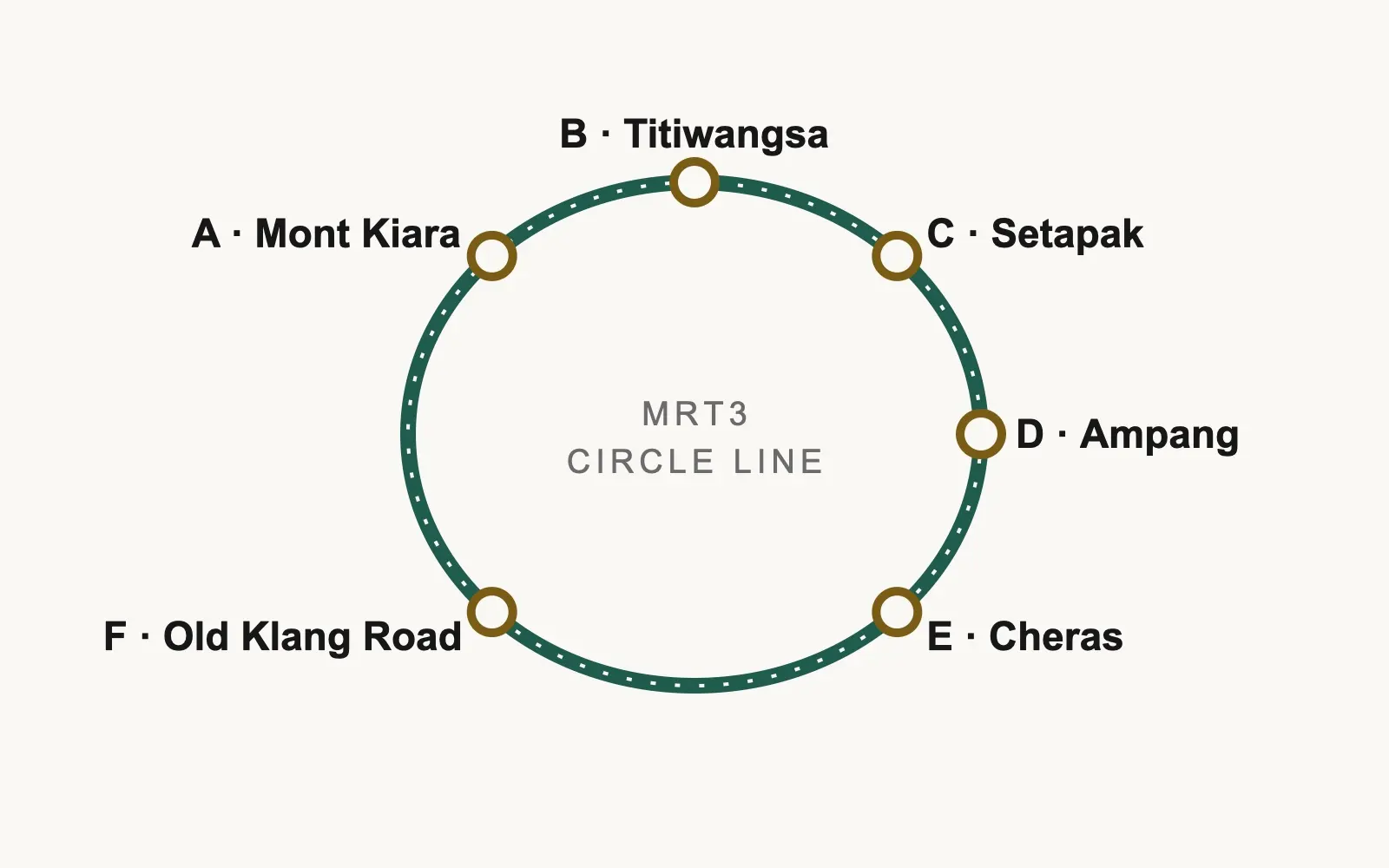
MRT3 can make an area better without making every condo there a better investment.
That is the distinction buyers need to understand before paying for a property marketed around the future Circle Line.
A new rail connection may make daily journeys easier, give a household more alternatives to driving and connect a neighbourhood to more of the city. Those benefits can be valuable.
But capital appreciation, rental demand and resale liquidity depend on more than transport. The purchase price still matters. So do competing supply, building quality, maintenance, layout and whether the eventual station is convenient to reach.
“Near MRT3” is therefore the beginning of a property assessment, not the conclusion.
The useful question is not simply which areas benefit. It is what MRT3 changes in each area—and how much of that change a residential property could realistically capture. The biggest MRT3 transport winner may not be the best MRT3 property buy.
MRT3 is more than a proposal—but it is not operating yet
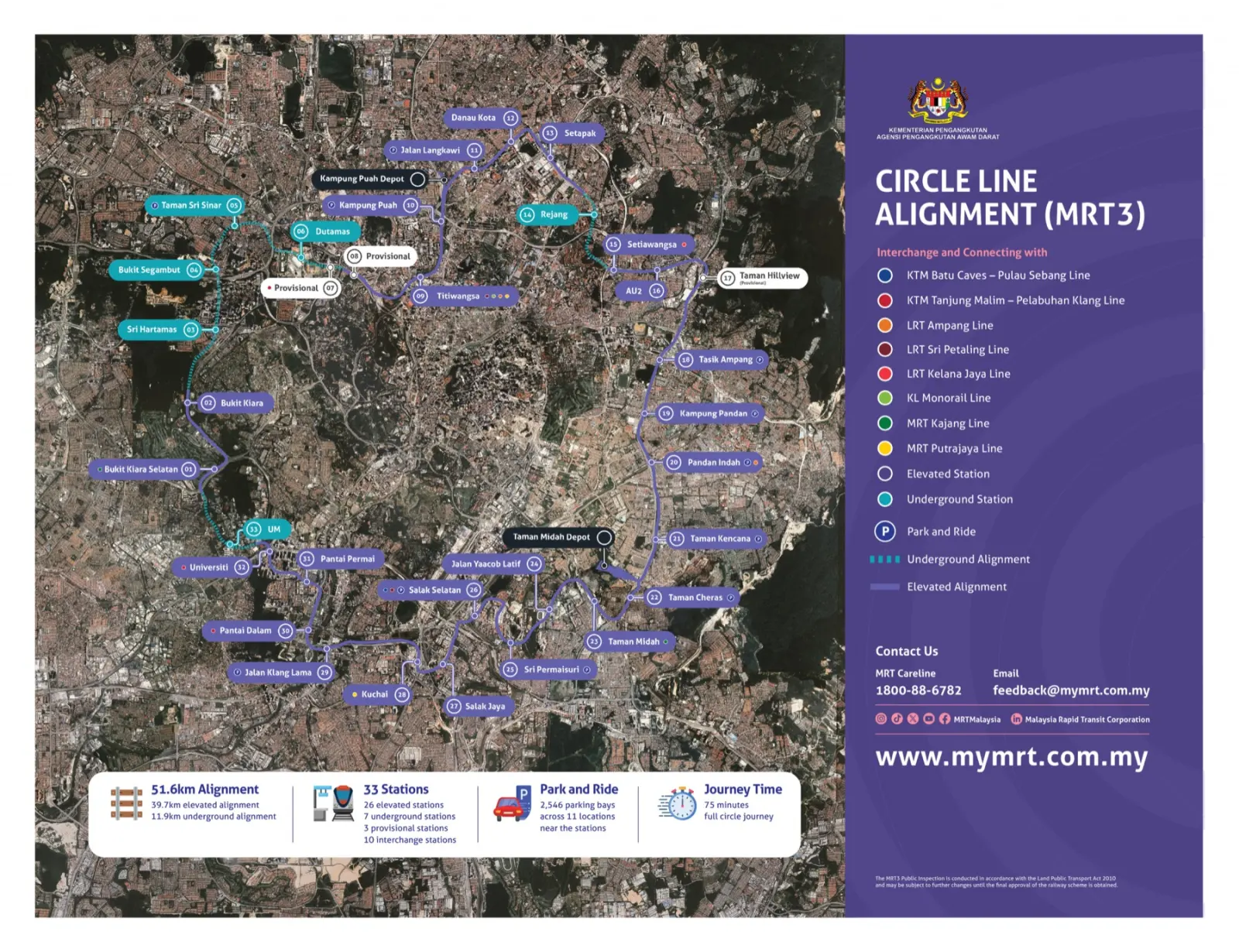
The MRT3 Final Railway Scheme was approved on 17 July 2025. MRT Corp said feedback led to changes in station and viaduct placement, and that approval enabled land acquisition to commence. MRT Corp approval release
MRT Corp’s latest official alignment panel shows approximately 51.6 km of alignment: 39.7 km elevated and 11.9 km underground. It lists 33 stations, comprising 26 elevated and seven underground stations, with three provisional stations included in the total, and 10 interchange stations. MRT Corp official alignment panel
The project is intended to add orbital and cross-city connections. For travellers, that could provide alternatives to journeys routed through the central business district. MRT Corp project overview
For buyers today, MRT3 remains a future benefit with execution and timing uncertainty. A purchase must survive the years before operations—and potentially a longer wait.
What Malaysia’s existing rail evidence actually shows
Malaysian studies show that rail access can affect property values, but the effect varies by location, property type, timing and methodology.
A 2013 Kelana Jaya Line study used hedonic house-price modelling and found a positive relationship between LRT proximity and residential values in its study area. That is evidence from a particular corridor and model, not a universal rail premium. Dziauddin, Alvanides and Powe, 2013
A 2019 Greater Kuala Lumpur study used geographically weighted regression to examine land-value uplift around LRT stations. It found considerable spatial variation in rail-related residential value effects. A single citywide premium is therefore an unsuitable basis for MRT3 cluster-level investment claims. Dziauddin, 2019
A 2022 SBK study estimated a post-operation premium for selected northwestern-corridor condominiums/service residences. It used 2012–2019 transactions and a hedonic pricing model, with a 0–0.4 km treatment zone and 0.85–1.5 km control zone. That specific result cannot be transferred directly to MRT3. Dziauddin, 2022
Historical evidence proves rail can matter. It does not prove what MRT3 will do to any specific cluster.
For an individual buyer, the harder question remains: how useful is the accessibility improvement, how much competition surrounds it, and what price must be paid to obtain it?
The wrong question: “Which MRT3 area will go up?”
That question combines different assessments.
MRT3 Mobility Impact asks how much MRT3 changes useful mobility: the journeys people can make, the transfers they can avoid and the destinations they can realistically reach.
Property Capture asks how much of that improvement could translate into residential investment outcomes: appreciation potential, achieved rent or resale liquidity.
Household/self-stay utility asks whether the home becomes more useful to the people living there. It is assessed separately from Property Capture.
An area can have strong Mobility Impact and only moderate Property Capture Potential.
Consider a neighbourhood where MRT3 creates a useful cross-city connection. Residents may gain a better journey to work or university. But if many similar condos offer the same connection, owners may still compete heavily on rent and asking price.
The transport improvement is shared across the neighbourhood. The investment result belongs to the individual property—and the price its buyer paid.
Existing rail access also does not make MRT3 irrelevant. A location can already have public transport yet benefit substantially from new orbital journeys and connections between rail corridors.
The question is what useful mobility MRT3 adds that the existing network does not provide well today.
The AskHenry framework
A practical way to assess the opportunity is:
MRT3 Property Value Potential = Access Gain − Friction − Competition − Price Already Paid
This is a decision framework, not a numerical valuation formula.
Access Gain: what becomes materially easier?
Start with actual journeys.
Does MRT3 provide practical rail access where it was previously difficult? Does it connect an awkward origin–destination pair, avoid a CBD-dependent transfer or improve access to employment, education, healthcare and commercial destinations?
For a household, the gain may be especially useful to someone without a car. For a landlord, it may broaden the pool of tenants who can reasonably consider the location.
A new station has more value when it solves a real travel problem.
Friction: what gets between the property and the benefit?
A map radius cannot tell you whether a journey is convenient.
The eventual entrance may be on the less accessible side of a major road. The route may involve gradients, uncovered walking or difficult crossings. An interchange may require more walking than expected.
Station design, construction disruption and exposure to tracks or station activity can also affect the property experience. Timing uncertainty adds another form of friction: a buyer pays holding costs while waiting for the benefit.
The relevant distance is the usable route from home to platform, not simply the straight line between two points.
Competition: who else offers the same accessibility?
MRT3 does not reserve its benefits for one development.
Existing condos, new high-rises, serviced apartments and competing rail-linked locations may all pursue the same tenants and buyers.
Where many units have similar layouts, prices and station access, improved connectivity may become a standard feature rather than a reason to pay substantially more for one unit.
Existing alternative rail lines matter too. The new property must compete against locations where rail is already operating.
Price Already Paid: how much future benefit is in today’s asking price?
MRT3 is already used in property marketing, including developer material that highlights the future line. Developer marketing example
That is different from proving that MRT3 has already been capitalised into transaction prices across a cluster. The evidence reviewed here does not establish the latter.
Buyers should therefore avoid both unsupported extremes: assuming the future benefit is free, or declaring that it is fully priced in.
Compare the purchase price with current transactions, achievable rent, condition and alternatives. If the price only makes sense after assuming future MRT3-driven gains, the buyer is taking on more than a transport bet.
The six MRT3 property clusters
The comparison below is AskHenry editorial analysis based on the available evidence, not a forecast. The official alignment panel provides the geographic context; the ratings are AskHenry’s judgment. MRT Corp alignment panel
Ratings describe potential at broad cluster level. They do not establish a premium, expected return or result for every neighbourhood within a cluster. Property Capture excludes self-stay utility. A Moderate rating means plausible but conditional investment capture; it does not mean measured rent growth or improved resale liquidity.
| Broad cluster | MRT3 Mobility Impact | Central distinction |
|---|---|---|
| Hartamas / Mont Kiara / Dutamas / Segambut | Strong | Could address a major rail-access weakness; a new valuation regime is unproven |
| Jalan Kuching / Titiwangsa / Sentul fringe | Strong | Greater network importance need not produce a proportional residential premium |
| Danau Kota / Setapak / Wangsa Maju / Setiawangsa | Strong | Useful additional connections; competing high-rise developments may dilute capture |
| Ampang / Pandan | Strong | Adds orbital options beyond existing radial rail; property outcomes remain unproven |
| Cheras / Taman Midah / Salak Selatan | Moderate | Mainly network flexibility, redundancy and new cross-city connections |
| Kuchai / Old Klang Road / Pantai Dalam / Universiti / UM | Very strong | Significant network and destination potential; competing developments matter |
Property Capture Potential: Moderate in all six clusters.
The repeated Moderate property ratings are intentional. Available evidence does not support a confident league table of investment winners.
A. Hartamas / Mont Kiara / Dutamas / Segambut
Existing public transport: Segambut has a KTM station, and MRT feeder routes serve parts of the surrounding northern cluster. Those connections should not be treated as convenient direct rail access for every Hartamas or Mont Kiara address. KTMB station directory, MRT Corp feeder routes
What MRT3 adds: Potentially a meaningful new rail option alongside orbital access to other corridors. The gain should not be dismissed merely because some residents own cars.
Mobility Impact: Strong. MRT3 could address one of the area’s clearest structural transport weaknesses, subject to usable station access. The existing-network map supports the distinction between surrounding rail connections and the lack of a station within much of the Hartamas–Mont Kiara residential area; actual convenience still requires an address-level check. Rapid KL integrated network map
Capital appreciation potential: An MRT3-specific uplift is uncertain. Schools and commercial amenities already form part of Mont Kiara’s proposition: Garden International School has a Mont Kiara campus and a Hartamas early-years centre, while 1 Mont Kiara combines retail and office uses. Garden International School locations, 1 Mont Kiara
For buyers, these are plausible demand drivers independent of rail, alongside the area’s residential reputation, international community, lifestyle and centrality. Their contribution to property values is not quantified here.
Tenant-pool expansion potential: Moderate. Additional connectivity could make the area relevant to more tenants. Rent uplift: Uncertain. Rail’s importance will differ by tenant profile.
Buyer-pool expansion potential: Moderate. Rail could remove an objection for some buyers. Resale liquidity improvement: Uncertain. A broader pool does not establish shorter selling times or higher resale values.
Self-stay utility: Strong potential, especially for household members who do not drive and for journeys where rail becomes a practical alternative.
Main counterargument: The accessibility improvement may strengthen an established proposition without creating an entirely new reason to pay a higher valuation.
B. Jalan Kuching / Titiwangsa / Sentul fringe
Existing public transport: Titiwangsa already combines Putrajaya MRT, Ampang/Sri Petaling LRT and monorail. Sentul has separate LRT and KTM relationships; those should not be described as KTM access at the Titiwangsa hub itself. Rapid KL integrated network map, KTMB station directory
What MRT3 adds: Another important network connection and more orbital journey options. Parts of the broader catchment may gain more than homes already served conveniently by existing rail.
Mobility Impact: Strong at cluster level. Network role at Titiwangsa: Very strong. Marginal mobility gain for a household already well served by existing rail: Moderate. These assess different things.
Capital appreciation potential: Uncertain. Existing connectivity means some properties already possess much of the rail advantage buyers value.
Tenant-pool expansion potential: Moderate. Additional route choices could broaden relevance to tenants with different workplaces or routines. Rent uplift: Uncertain. The effect depends on the property’s current access and competing stock.
Buyer-pool expansion potential: Moderate. More journey options may help some buyers consider the location. Resale liquidity improvement: Uncertain. An important interchange does not automatically create a premium.
Self-stay utility: Strong potential where MRT3 simplifies a recurring journey. This is compatible with a Moderate marginal gain for households whose existing rail options already work well.
Main counterargument: Network importance and new residential value are not proportional. A hub can become more important without nearby homes becoming the largest property winners.
C. Danau Kota / Setapak / Wangsa Maju / Setiawangsa
Existing public transport: This cluster is not disconnected. Wangsa Maju and Setiawangsa have Kelana Jaya Line stations. Rapid KL also lists bus and on-demand connections in the wider catchment. These services do not make every address equally convenient to rail. Rapid KL integrated network map, Rapid KL bus services, Rapid KL on-demand services
What MRT3 adds: Orbital connectivity, access to other rail corridors and potentially more residential catchments within practical rail reach. Danau Kota, Setapak and Rejang may gain differently from locations already close to the Kelana Jaya Line.
Mobility Impact: Strong. Additional connections could be useful for residential and education-related journeys. TAR UMT’s Kuala Lumpur main campus is in Setapak; whether MRT3 improves a particular student’s trip remains a route-level question. TAR UMT campus contact information
Capital appreciation potential: Uncertain. Better connectivity alone does not establish scarcity or pricing power.
Tenant-pool expansion potential: Moderate. A wider range of workable journeys could expand tenant consideration, including education-related demand. Rent uplift: Uncertain. Tenant-pool expansion is not the same as rent growth.
Buyer-pool expansion potential: Moderate. Additional access could broaden consideration. Resale liquidity improvement: Uncertain. Similar units may still struggle to stand out.
Self-stay utility: Strong potential where MRT3 makes work, study or family journeys meaningfully easier.
Main counterargument: Documented high-rise development activity creates a competition question. EdgeProp’s September 2024 exercise counted nine under-construction developments within its 1 km radius around the then-proposed Setapak station, while its April 2026 report identified further non-landed pipeline activity in Setapak. These are development snapshots, not evidence of district-wide oversupply, vacancy or weak absorption. EdgeProp development snapshot, 2024, EdgeProp pipeline report, 2026
For buyers, the district can become more connected while an individual condo still struggles to differentiate itself.
D. Ampang / Pandan
Existing public transport: Ampang and Pandan already have Ampang Line stations, including Ampang and Pandan Indah, alongside bus services. MRT3 should not be presented as their first public-transport connection. Rapid KL integrated network map, Rapid KL bus services
What MRT3 adds: Orbital movement beyond the existing radial rail pattern, new cross-network connections and potential coverage improvements for residential catchments outside convenient current station access.
Mobility Impact: Strong. The relevant gain is whether cross-city journeys become materially more practical.
Capital appreciation potential: Uncertain. Current evidence does not establish a cluster-wide uplift or investment outperformance.
Tenant-pool expansion potential: Moderate where new connections match tenants’ actual destinations. Rent uplift: Uncertain. A line on the map is insufficient evidence of additional rent.
Buyer-pool expansion potential: Moderate. More buyers might find particular locations workable, subject to station access, price and the property’s other attributes. Resale liquidity improvement: Uncertain.
Self-stay utility: Strong potential for households whose current journeys involve awkward transfers or substantial driving.
Main counterargument: The gain varies with the starting point. A home already conveniently served by the Ampang Line has a different case from one outside an easy existing catchment.
E. Cheras / Taman Midah / Salak Selatan
Existing public transport: Taman Midah has Kajang Line MRT access. Salak Selatan has separate Sri Petaling LRT and KTM stations; their shared locality name should not imply a seamless interchange. Other parts of Cheras have existing rail access too. MRT Corp Taman Midah station, Rapid KL integrated network map, KTMB station directory
What MRT3 adds: More network flexibility, route redundancy and new cross-city connections.
Mobility Impact: Moderate. This does not dismiss the area. Some household journeys could improve substantially, but the broad story is less about first-time rail access.
Capital appreciation potential: Uncertain. Additional connectivity must be assessed against the accessibility a property already offers.
Tenant-pool expansion potential: Moderate where the new route opens useful destinations for tenants. Rent uplift: Uncertain.
Buyer-pool expansion potential: Moderate. Extra route choice may strengthen the proposition. Resale liquidity improvement: Uncertain. Current evidence does not show a general improvement in resale outcomes.
Self-stay utility: Moderate potential at cluster level, potentially stronger for particular journey patterns.
Main counterargument: Buyers may pay for “future rail access” without checking how much of the claimed advantage already exists today.
F. Kuchai / Old Klang Road / Pantai Dalam / Universiti / UM
Existing public transport: Kuchai has Putrajaya Line access, Universiti is on the Kelana Jaya Line, and Pantai Dalam has a KTM station. MRT Corp lists Kuchai feeder connections to Jalan Klang Lama and surrounding neighbourhoods. These are distinct access points, not convenient rail coverage for every address in this extensive cluster. MRT Corp Kuchai station, Rapid KL integrated network map, KTMB station directory, MRT Corp feeder routes
What MRT3 adds: Multiple important network connections and potential access improvements around education, healthcare and commercial destinations. Universiti Malaya and UMMC are in the Lembah Pantai area, while Mid Valley is a commercial destination on Lingkaran Syed Putra. Universiti Malaya location, UMMC official portal, Mid Valley location
For households travelling to these destinations or the wider Bangsar–Mid Valley area, MRT3 could provide useful alternatives. The gain depends on the complete journey, including transfers and final access; destination presence does not prove a new tenant flow.
Mobility Impact: Very strong. The combination of connections and destinations creates substantial potential mobility value. That does not mean MRT3 will solve congestion.
Capital appreciation potential: Uncertain. Centrality and connectivity must be weighed against purchase price and competing supply.
Tenant-pool expansion potential: Moderate. Workers, students, medical staff and professionals could value useful new routes. Rent uplift: Uncertain.
Buyer-pool expansion potential: Moderate. Better access could widen consideration. Resale liquidity improvement: Uncertain. Multiple competing developments may limit differentiation.
Self-stay utility: Strong potential for households whose regular destinations align with the new network.
Main counterargument: Old Klang Road has documented high-rise development activity. Historical reporting listed multiple condo and serviced-residence developments, and EdgeProp’s April 2026 pipeline report also includes Jalan Klang Lama. These establish development competition to investigate, not a current area-wide oversupply finding or a measured count of comparable units. EdgeProp historical development context, EdgeProp pipeline report, 2026
MRT3 may improve Old Klang Road more reliably than it improves every Old Klang Road condo.
Looking at a specific project?
The Mont Kiara paradox
If Mont Kiara gains practical rail access, why is it not automatically the biggest MRT3 property winner?
Because removing a weakness and creating a new investment engine are different things.
Mont Kiara already has schools and commercial amenities that do not depend on future MRT3 operations. Garden International School and 1 Mont Kiara are examples of that existing context. Garden International School locations, 1 Mont Kiara
For buyers, those amenities, lifestyle and the area’s established residential identity may contribute to its appeal independently of rail. MRT3 could strengthen that proposition. A household that previously rejected the area because one member could not drive might reconsider. An existing resident might gain a practical alternative for selected trips.
As AskHenry analysis, MRT3 may remove one reason to reject Mont Kiara rather than create the reason to buy Mont Kiara.
That is meaningful. But it does not establish how much more buyers will pay, whether rents will rise broadly or whether resale will become easier across the cluster.
The investment question is whether the specific purchase price leaves room for that improvement to matter.
When an area wins but your condo does not
Setapak and Old Klang Road illustrate the difference between a neighbourhood benefit and an owner’s return.
Suppose MRT3 makes an area easier to reach and relevant to more tenants. Rental interest could broaden.
But if many comparable units pursue those tenants, landlords may still compete on price, furnishing and condition. Greater interest does not necessarily translate into strong rent growth.
The same applies to resale. Better connectivity could bring more potential buyers into consideration, while abundant alternatives make it difficult for one seller to command a premium.
A neighbourhood can become more connected and more desirable while an owner still faces weak differentiation and price competition. This is a mechanism, not a claim that MRT3 has already produced those outcomes.
This is why station access must be assessed alongside layout, maintenance, running costs, building condition and competing units. MRT3 cannot make every property equally attractive.
Capital gain is not the same as rent, liquidity or self-stay value
“Property benefit” is too broad to guide a purchase.
A home might become more convenient without producing a measurable capital premium. It might attract a wider tenant pool without supporting higher rent. It might appeal to more buyers without selling quickly at the owner’s desired price.
The following matrix separates those outcomes.
These are qualitative assessments of potential, not predictions. Moderate tenant/buyer-pool ratings describe plausible consideration expansion, not measured demand. Uncertain outcome ratings mean the reviewed evidence does not establish an MRT3-specific improvement. Self-stay utility is a separate household assessment.
| Outcome | Rating in all six clusters |
|---|---|
| Capital appreciation potential | Uncertain |
| Tenant-pool expansion potential | Moderate |
| Rent uplift | Uncertain |
| Buyer-pool expansion potential | Moderate |
| Resale liquidity improvement | Uncertain |
| Self-stay utility | Strong potential; in Cheras / Taman Midah / Salak Selatan: Moderate potential |
The available evidence provides a firmer basis for discussing potential self-stay utility than for claiming investment outperformance in several clusters. That is an assessment of the evidence and mobility mechanisms, not a measured household benefit.
That distinction matters financially. A household may reasonably value a better daily routine even when an investor cannot justify paying a premium on expected returns.
Should you buy before MRT3—or wait?
There is no universal answer.
The decision rule is:
Buy before MRT3 only if the property already works without MRT3.
Buying early may make sense when current fundamentals support the purchase, the price is competitive, the holding period is long and credible future station access provides additional upside.
For an investor, that means assessing current achievable rent, costs and resale alternatives. For an owner-occupier, it means the home already suits the household’s location, budget and daily needs.
Waiting may be smarter when the asking price depends heavily on MRT3 marketing, eventual access is unclear or the current rental and resale case is weak. Substantial competing future supply and a possible sale before operations also make the early-purchase case harder.
For example, a household buying a suitable home for a long stay may value future rail optionality. A buyer planning to sell within a few years must depend much more on demand before the railway operates.
A delay does not automatically make a purchase bad. It reveals whether MRT3 was additional upside—or whether the investment required it to work.
Five questions before paying for an MRT3 story
- What trips become realistically easier with MRT3 that are difficult today?
- Can I actually reach the eventual station conveniently, or am I buying a map radius?
- Would this property still work for rent, resale or self-stay if MRT3 takes longer than currently expected to become operational?
- How many similar units will compete for the same tenant or buyer before MRT3 operates?
- Am I paying for current property value—or already paying today for a future MRT3 story?
Specific answers are more useful than a general claim that the property is “near the future MRT”.
What buyers should take from MRT3
MRT3 should be treated as a multiplier of good property fundamentals, not a substitute for them.
A strong property does not suddenly become weak because MRT3 is absent. A weak property does not automatically become strong because MRT3 is coming.
The best early MRT3 purchase is likely to be a property that already makes sense today—with MRT3 providing additional future optionality rather than rescuing the investment case.
Tell me the project you are considering. I’ll help you check whether MRT3 genuinely improves the property — or whether you are mainly paying for the story.