RTS Is Opening Soon: Is It Already Too Late to Buy Property Near JB CIQ?
RTS Hasn't Opened Yet. Doesn't That Mean I'm Still Early?
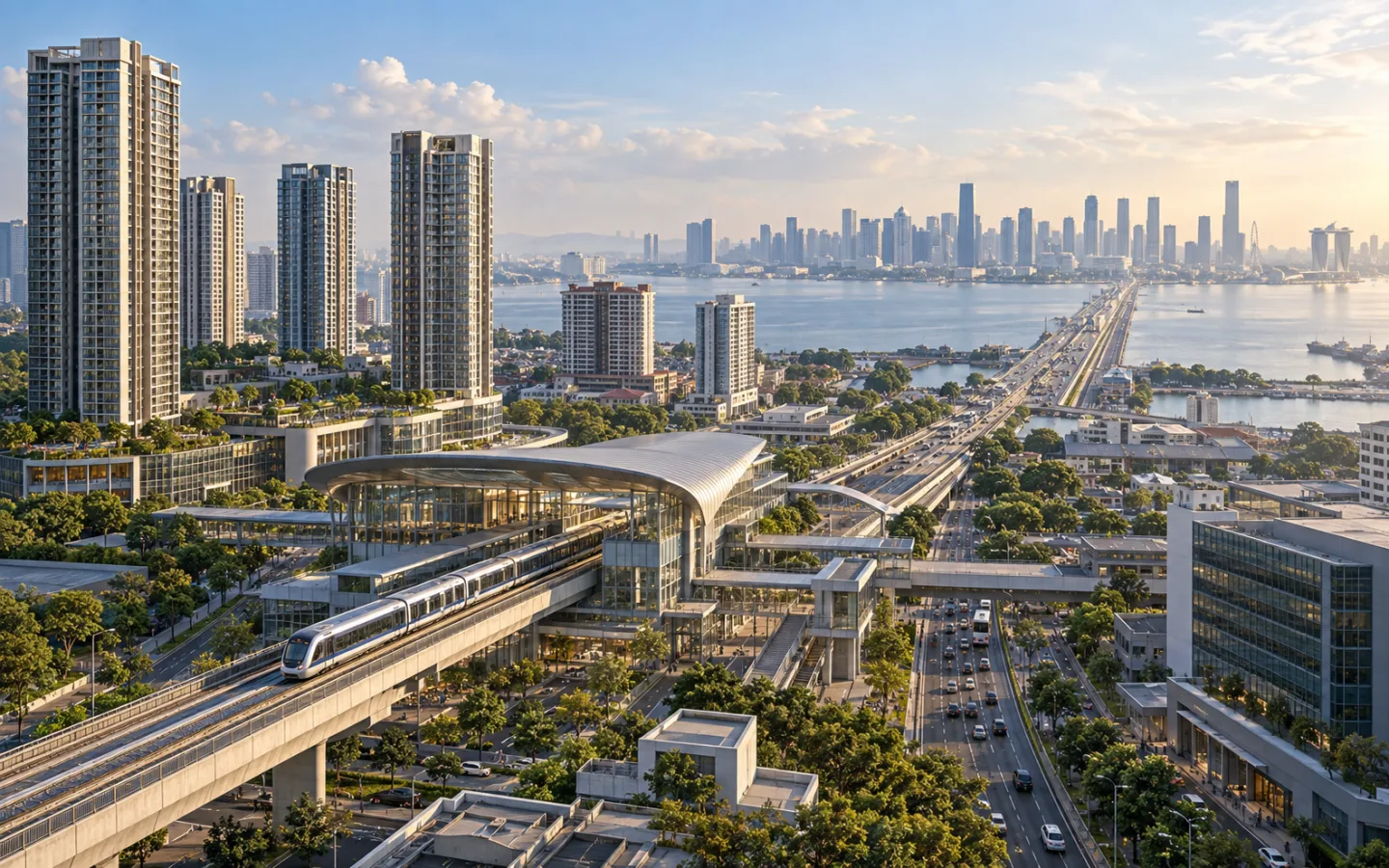
By August 2026, the Bukit Chagar station and immigration complex were reported physically complete, with the project in system integration, commissioning and trial running. Singapore's side of the rail systems work was reported at roughly 56% in July 2026, and the first train had already been unveiled. Service is targeted around the turn of 2026/27.
So no — you're not buying a secret. Every seller and developer near CIQ already knows RTS is coming, and pricing already reflects that.
But nobody has yet watched a full year of commuters relying on RTS every workday, watched households actually relocate because of it, or seen whether landlords can sustain today's asking rents once the new supply completes. That's the gap this article is built around:
Before RTS opens, you are buying uncertainty at today's price. After RTS proves itself, you may be buying certainty at tomorrow's price.
So What Does "Too Late" Actually Mean?
The lazy definition — prices have risen, so the opportunity is gone — isn't useful. Prices near confirmed infrastructure rise before it opens; that's normal.
A better definition:
"Too late" means the price you're being asked to pay already requires future rent growth, appreciation, or liquidity that isn't yet reasonable to assume.
The mirror risk: wait until the evidence is obvious, and you may be buying after the best-located projects have already re-rated. Rail research elsewhere shows meaningful value gains can occur once operations start and prove themselves, on top of whatever was already priced during construction. Waiting isn't free. It can mean paying a proof premium.
Price versus certainty — not "now versus later." Everything below helps you weigh that trade-off for a specific property.
What's Already Priced In, and What Genuinely Isn't
Substantially known:
- RTS is close to operational — structures complete, in testing, service targeted late 2026/early 2027
- A roughly five-minute crossing between Bukit Chagar and Woodlands North, capacity up to 10,000 passengers per hour per direction, immigration cleared once
- Connection into Singapore's MRT network via Woodlands North
- JS-SEZ has real bilateral backing — established January 2025, targeting 50 projects and 20,000 skilled jobs within five years, with roughly RM77 billion in approved 2025 investment reported (how much of that maps to jobs within realistic CIQ commuting distance is not yet known)
Still unproven — can't be priced before people actually use the train:
- Whether border clearance is reliably fast at peak hours, daily, not just on a trial run
- Whether commuters adopt RTS at scale, and whether households actually relocate because of it
- Achieved rents and sustained occupancy — everything published now is asking-price and asking-rent portal data, not signed leases
- Resale liquidity once the new supply completes
- Whether Johor's roughly 9,000–10,000 completed, unsold serviced apartments (state-level NAPIC-referenced figures) actually compete with CIQ-specific stock
Infrastructure can be priced before it opens. Behaviour can't be fully priced until people actually use it.
Why There Might Still Be a Second Re-Rating
RTS's core value isn't "another train station" — it's predictability of a crossing that's currently unpredictable: a scheduled five-minute rail trip with immigration cleared once, replacing a Causeway crossing that can range from manageable to a multi-hour ordeal. The gap between "the crossing usually takes about this long" and "I can reliably be at my desk by a fixed time, every weekday" is the kind of change that's hard to price until it's been lived, not just projected.
This is plausible, not certain. Studies of comparable rail projects elsewhere — a Kuala Lumpur MRT line, several Hong Kong lines — have found price premiums building through construction and, in some cases, continuing or even growing once service actually began. None of this transfers mechanically to JB's cross-border, immigration-cleared context. It's a reason not to assume the opposite — that the story is fully priced in — with more confidence than the evidence supports.
There is upside risk to waiting. Not guaranteed upside from buying.
RTS Can Succeed and Your Condo Can Still Fail
For RTS to become a good investment in a specific unit, a chain has to hold: RTS operates reliably, commuters actually adopt it, some choose to live near CIQ, demand reaches your specific project and unit type, occupancy and rent hold up against competing supply, and resale buyers show up later at a workable price.
RTS can be an outright success — high ridership, smooth operations — and your unit can still underperform, if you paid a price assuming the best case, your project has thousands of near-identical competing units, your real walking route is worse than the marketing map, or service charges eat your rent. RTS success is a precondition for a strong outcome here. It is not, by itself, proof that any particular purchase works.
RTS is not the investment. The property you buy, and the price you pay for it, is the investment.
Who Will Actually Create Demand?
Before asking how much supply exists, it's worth asking who's actually going to want these units:
- Malaysians working in Singapore — one of the clearest housing-demand segments to monitor after opening, likely wanting studios to two-bedroom units with a premium on reliable commute time
- JS-SEZ professionals — plausible, but only if their job location and salary support premium central-JB rents; JS-SEZ figures are reported at zone level, not mapped to CIQ commuting catchments
- Expatriates working in Johor — a real but project-specific driver, usually tied to employer housing budgets and schooling, not a blanket demand source
- Short-stay and corporate users — plausible but not equivalent to stable annual tenancy
- Cross-border couples and hybrid workers — a segment RTS could enable, with no verified demand count yet
- Singapore-linked second-home buyers — likely to prioritise flexibility over commute optimisation, pointing them to different units than a daily commuter
RTS plausibly broadens the pool of potential tenants and buyers. It doesn't prove any of these groups will show up in the numbers a specific project needs.
The Supply Question
Johor's completed-unsold serviced-apartment stock has been reported at roughly 9,000–10,000 units at the state level. That gets quoted as proof of CIQ oversupply — but it's a risk prior, not a micro-market conclusion. It mixes districts, tenant pools, completion eras and, critically, access to Singapore. The better question:
How much genuinely substitutable supply — same tenant segment, similar access, similar price point, similar completion window — is actually competing for the same buyer or tenant?
The two named CIQ/Bukit Chagar projects with publicly reported unit counts — CTC SkyOne (1,605 units) and Causewayz Square (3,692 units released) — total roughly 5,300 units, marketed, third-party figures, not the full pipeline.
As a sensitivity exercise, not a forecast, here's what different rates of new households choosing central JB, for any reason connected to RTS, would mean for that pipeline over five years:
| Scenario | New households/year | Units absorbed over 5 years | Share of ~5,300-unit pipeline |
|---|---|---|---|
| Conservative | 250 | 1,250 | 24% |
| Base case | 600 | 3,000 | 57% |
| Aggressive | 1,200 | 6,000 | 113% |
This doesn't mean 600 households a year will relocate, and daily Causeway crossings aren't a clean household-demand denominator — they mix repeat commuters, non-residential trips and people who won't ever consider relocating. The exercise only shows that a large supply number alone doesn't prove absorption is impossible.
The arithmetic isn't obviously impossible. The conversion rate is simply unknown. The real risk isn't "many units" — it's too many interchangeable units chasing the same tenant at the same time.
Density: Risk or Ecosystem?
A large project isn't automatically a red flag. It can go either way.
Risk: investor-heavy, largely identical units, competing on discount rather than differentiation.
Advantage: deep rental and resale market, real retail and food ecosystem, a project agents and banks understand well enough to value confidently.
The question isn't "how many units?" It's whether a project creates anonymous, substitutable supply — or becomes the recognised market for a specific tenant category.
What Might Actually Win Near RTS
Four things I'd weigh, ranked by how testable they are:
1. Effective accessibility, not the brochure distance. "300m from RTS" is a straight-line claim. What matters: door-to-fare-gate time from the lift lobby, sheltered continuous routes, road crossings, and total door-to-workplace time including the Woodlands North transfer. Proximity research elsewhere isn't strictly linear — some studies find the strongest uplift in a wider band, roughly 300m to 1,200m, rather than immediate adjacency, since being right on top of a station can bring noise and congestion that offset the benefit.
2. For a commute-led tenant, I would prioritise: reliable access, functional layout, lift reliability, security, late-night access, food and grocery convenience, practical furnishing, maintenance quality. This is a decision framework, not proven tenant-preference data.
3. Market position. Is this becoming the recognised RTS commuter building, or one of many near-identical towers competing on discount? Is there any early sign of a real resale pool beyond speculative investors?
4. Price, and what it's buying. Covered next.
New Launch vs. Completed: How to Compare
R&F Princess Cove is a useful benchmark — completed, transacted, with a visible rental market — but easy to misuse. Don't do this: "R&F asks around RM890 psf, this launch is RM1,350 psf, so buyers are paying a 50%-plus RTS premium." That gap can contain age, unit condition, layout, management, view, tenure, marketing rebates and genuinely different practical access — none of it RTS-specific.
After adjusting for those differences, does the new project still offer enough structural advantage to justify what's left of the premium?
A new launch may deserve a premium over a completed alternative. The premium has to be explained, not assumed.
Investor Type and the Yield Question
Using current asking-rent data, not signed leases, a RM1 million unit at RM3,000 a month rent works out to roughly 3.6% gross — before maintenance, assessment, vacancy, letting fees and management, which typically pull the net figure lower. That's a real constraint, but not the only lens:
| Investor type | What to measure |
|---|---|
| Income investor | Stabilised net yield, vacancy resilience, achievable rent against real comparables |
| Capital-growth investor | Structural access advantage, market recognition, resale liquidity, relative price performance |
| Hybrid investor | Whether a conservative rent scenario is tolerable, with plausible appreciation on top |
A 3-4% gross yield isn't automatically disqualifying — but if you're accepting it, you need to know what's supposed to compensate: rent growth, appreciation, or liquidity. This distinction connects directly to timing:
An income-led investor should generally demand more operating proof, because rent and occupancy carry more of the thesis. A long-horizon capital-growth buyer may rationally accept more pre-opening uncertainty if the project has unusually strong structural access and liquidity potential. A hybrid buyer should stress-test both.
Buy Now, Right After Opening, or Wait?
| Timing | You accept | You may gain |
|---|---|---|
| Before opening | Behavioural, rent/occupancy and supply-absorption uncertainty | Earlier pricing, better unit selection, possible operating-stage re-rating |
| Right after opening | Noisy early data; the first repricing may already occur | Real operating evidence — border speed, ridership, early demand |
| Wait 12-24 months | The strongest projects may already carry a proof premium | Achieved rent, occupancy, absorption and resale data |
The right choice depends partly on what return you're underwriting. An income investor should lean toward more proof before buying. A capital-growth investor with a long horizon may reasonably accept more uncertainty for a genuinely well-positioned project. A hybrid buyer sits in between and should stress-test both a conservative-rent and a delayed-proof scenario before committing.
There is no universal timing answer. There is a different evidentiary threshold for different buyers.
If you buy before opening: stress-test against a conservative rent, not the best asking-rent example; walk the actual route at weekday peak hours before committing; and know explicitly whether your thesis rests on income, appreciation, or both.
If you're weighing two specific RTS-area properties right now, send Henry the project names and actual prices for a comparison of entry price, effective access, competing supply and the investment hurdle each one needs to clear, before you decide.
What Would Make Henry More Bullish
Not more RTS ridership headlines — property-level evidence: rent growth, occupancy, absorption and resale liquidity at the best-access projects clearly outperforming both wider Johor and less-walkable central-JB alternatives, while new supply absorbs without heavy discounting.
What Would Make the Thesis Fail
Strong ridership, but flat rent, weak occupancy, no outperformance at the best-access projects, heavy discounting to sell down the pipeline, and thin resale liquidity — that combination would mean the infrastructure worked, but the property thesis didn't convert into investor value. A real possible outcome, not a hypothetical one.
So — Too Late, or Not?
No, it is not automatically too late. But you are no longer buying an undiscovered catalyst.
A buyer today is choosing between uncertainty at today's price and proof at tomorrow's price.
The real question is whether the specific property you are buying can capture enough of the RTS benefit to justify what you are paying today.
RTS is not the investment. The property you buy, and the price you pay for it, is the investment.
Sources
- The Star — RTS Link commissioning status and KTM pedestrian-bridge approval, Aug 2026 - Station/ICQ physical completion, testing status, targeted opening window, KTM bridge lag (as of 4 Sep 2026)
- PropertyGuru — R&F Princess Cove Phase 1, for-rent listings - Asking-rent ranges and rental-listing volume at a completed CIQ-area benchmark project (asking data, not achieved rent) (as of 4 Sep 2026)
- NAPIC/JPPH — Malaysia property market reports (Johor completed-unsold serviced-apartment overhang) - State-level ~9,000-10,000 completed, unsold serviced-apartment figure used as a risk prior, not a CIQ-specific conclusion (as of 4 Sep 2026)
- Malaysia Property 4U — Johor Bahru project guide (CTC SkyOne, Causewayz Square, R&F Princess Cove Phase 2 unit counts) - Marketed unit counts and distances for the CIQ/Bukit Chagar new-launch pipeline; unverified against APDL/approved plans (as of 4 Sep 2026)
- The Straits Times — Johor-Singapore Special Economic Zone (JS-SEZ) investment and job targets - JS-SEZ establishment date, 50-project/20,000-job target, approved-investment figure (as of 4 Sep 2026)
- Journal of the Association of Geographers Malaysia — MRT station proximity price-premium study (Greater Kuala Lumpur) - Comparable-market evidence for construction-stage vs. operating-stage rail price premiums; not mechanically transferable to JB (as of 4 Sep 2026)