Tagbay Suites Investment Review: Is a Low Entry Price Really Enough?
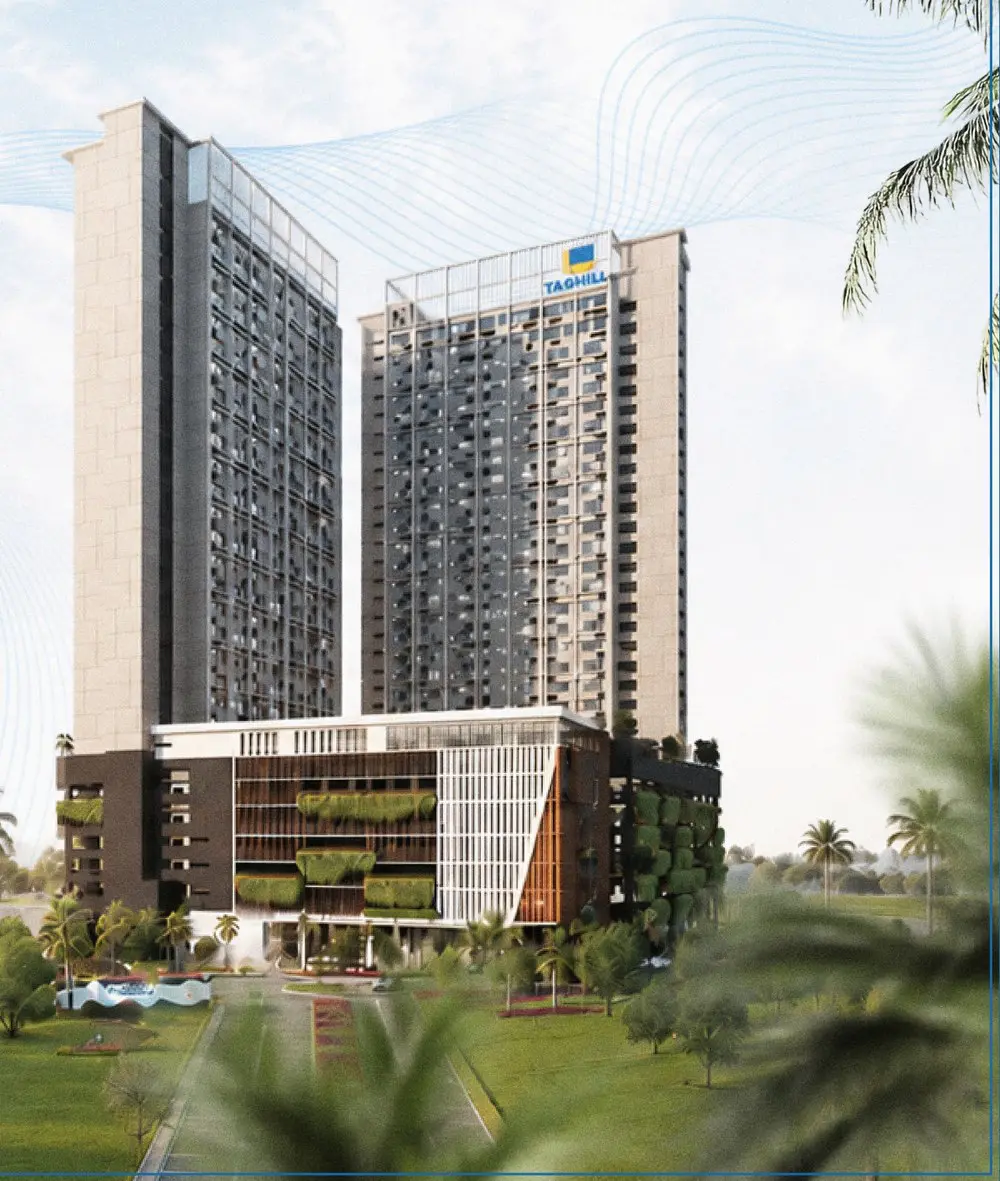
Most buyers meet Tagbay through its price. The entry number is low enough that people stop doing mental arithmetic and start feeling that it is affordable.
That feeling is worth examining, because a low ticket price tells you what the purchase costs. It tells you nothing about what the asset earns.
Tagbay is not a condo that happens to be furnished. It is a short-stay hospitality unit, and it earns like a small hospitality business: nightly rate, occupancy, cleaning, linen, utilities, distribution, operator fees, maintenance, sinking fund, furniture replacement, vacancy and seasonality. Every one of those items sits between the guest's payment and the owner's bank account.
Judged as a condo, it looks inexpensive. Judged as a hotel room you happen to own, a different question appears, and it is the only question that decides the outcome.
Tagbay may be easy to buy. The real question is whether it is cheap enough to own as a business.
Why Tagbay Looks Attractive (And What Each Reason Actually Proves)
A buyer considering Tagbay has usually heard six things. All six are reasonable observations. None of them settles the investment question, and it is worth being precise about why.
| What you hear | What it genuinely supports | What it does not prove |
|---|---|---|
| Low entry price | A smaller capital commitment and a lower absolute loss ceiling. Real, and not trivial. | That the price is low relative to income. A small number that still requires strong operating performance is not a margin of safety. |
| Melaka tourism is strong | Visitor demand for Melaka is real and sustained. | That paid room nights are scarce. Arrivals include day-trippers and visitors staying elsewhere. Arrivals are not room nights. |
| Near Jonker | Guests value proximity to Melaka's main attraction, which supports the location's relevance to the leisure market. | That Tagbay can charge what genuinely central stock charges. Proximity and pricing power are different things. |
| Sea view | A rate argument for a subset of guests, particularly at weekends and holidays. | That the unit will be occupied. A view supports ADR; it does not underwrite occupancy. |
| Mana Mana manages it | Professional operations, unified standards and a lower chance of amateur execution errors. | Owner profitability. Operator involvement establishes competence, not distributions. |
| You don't manage Airbnb yourself | A genuine saving of time and effort, and the removal of a real barrier for foreign or out-of-state buyers. | That the economics work. Convenience is a cost you avoid, not income you gain. |
Read that table as a single argument: every attraction on the list is real, and not one of them is evidence about return. Something else has to carry that weight.
What This Investment Has to Prove
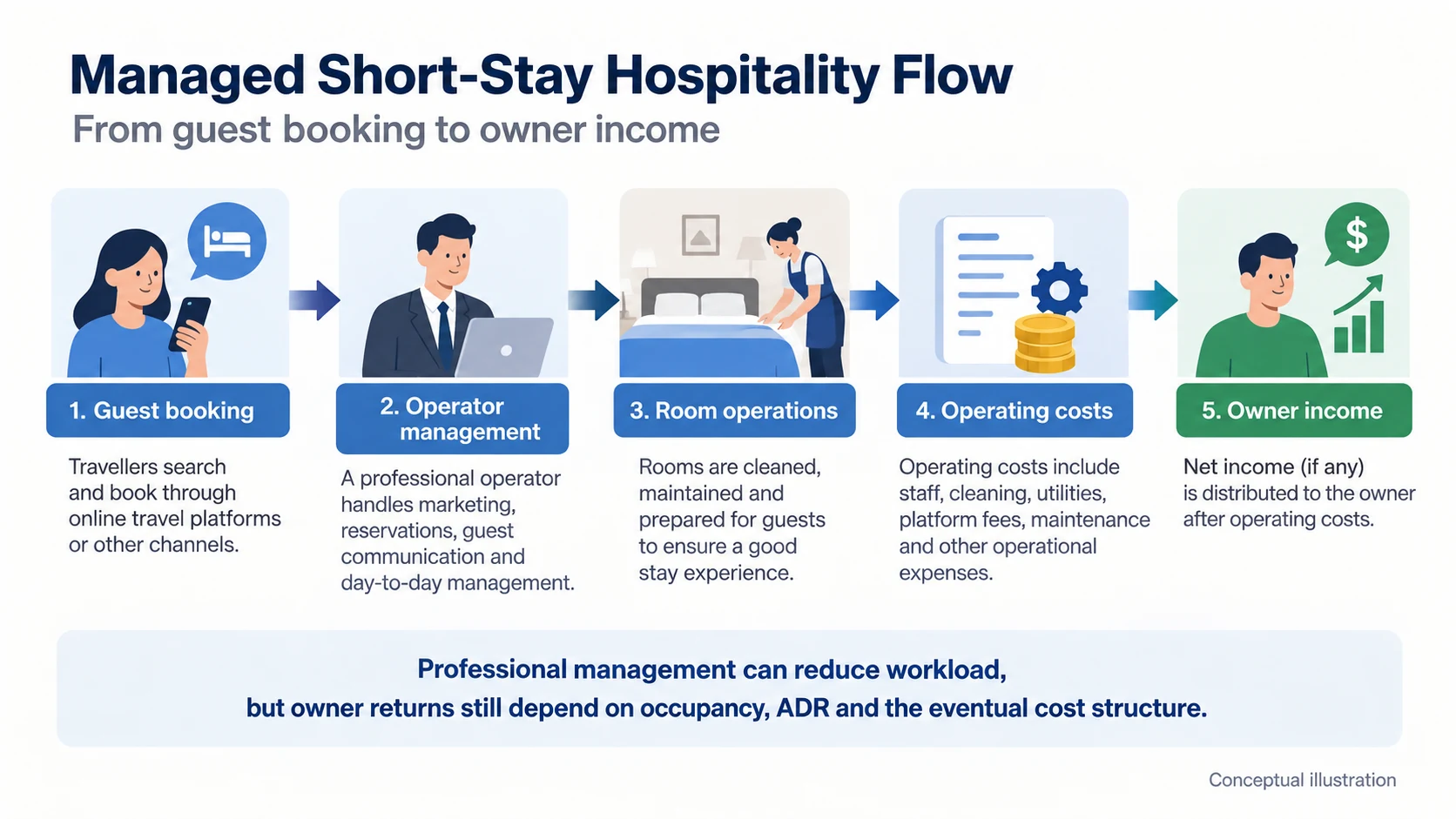
You are not buying a normal condo — you are buying a hospitality business
A long-term rental condo has one income line and a short cost list: maintenance fee, assessment, quit rent, insurance, occasional repairs, occasional vacancy. The tenant pays utilities and lives with the furniture.
A short-stay hospitality unit has one income line and a long cost list.
| Long-stay condo | Short-stay hospitality unit | |
|---|---|---|
| Income basis | Fixed monthly rent | Nightly rate times occupancy, variable and seasonal |
| Who pays utilities | Tenant | Owner |
| Cleaning and linen | Tenant's problem | Every checkout, at the owner's cost |
| Consumables | None | Toiletries, coffee, water, replacements |
| Distribution cost | One agent commission, occasionally | Listing, channel management and platform commission on most bookings. Depending on the contract, this may sit with the owner or inside an operator's scope of service |
| Management | Optional, low fee | Operator fee, ongoing |
| Furniture and appliances | Tenant's or minimal | Owner's, with hotel-grade wear and periodic replacement |
| Vacancy | Weeks between tenancies | Empty nights, every week |
| Seasonality | Negligible | Material |
That distribution row deserves attention, because it is where most amateur models go wrong in both directions.
In a self-managed short-stay unit, platform commission is unambiguously an owner cost, deducted on top of whatever the owner spends on their own listing and marketing time. In a professionally managed building, the picture is different. A hospitality operator's fee typically covers a bundle of functions rather than a single service, and that bundle commonly includes online travel listing and channel management, sales and marketing, CRM, IT and property-management systems, back-office support and general operational management. Where that is the arrangement, deducting a separate platform commission on top of the operator's fee counts the same layer twice and understates net income.
Which structure applies at Tagbay is a contract question, not a modelling question, and it is not publicly established. Section by section below, this article models the managed structure and flags it as an assumption.
Tagbay's maintenance is a published figure: RM0.32 psf inclusive of sinking fund. On a 495 sqft Standard Suite that is roughly RM158 a month, or about RM1,900 a year. That is a verified project fact and one of the few cost lines that can be stated with confidence.
Two other project facts belong in the cost conversation. The development is on commercial title under HDA. Commercial title can affect utility and assessment treatment, but the actual tariff and assessment basis should be verified for Tagbay rather than assumed from the title alone, and it is worth confirming line by line rather than working from a general expectation. And the fully furnished package is not automatically included; it is tied to selected hospitality service packages. A buyer should establish clearly whether furniture and appliance capital expenditure sits with them or with the operator, because it is a recurring item, not a one-off.
Three ways the case can work
Given that cost stack, there are exactly three routes to a good outcome.
One: stronger sustainable RevPAR and NOI. The building earns more per available room-night than the surrounding market, consistently, and the income survives the cost stack.
Two: a sufficiently low effective acquisition cost. The buyer pays little enough that ordinary operating performance still clears their required return.
Three: lower operating leakage. The cost stack takes materially less than conservative assumptions suggest, whether through scale, direct-booking mix, or efficient operations.
Everything that follows is a test of one of these three.
The Demand Question: Melaka Arrivals Are Not Room Nights
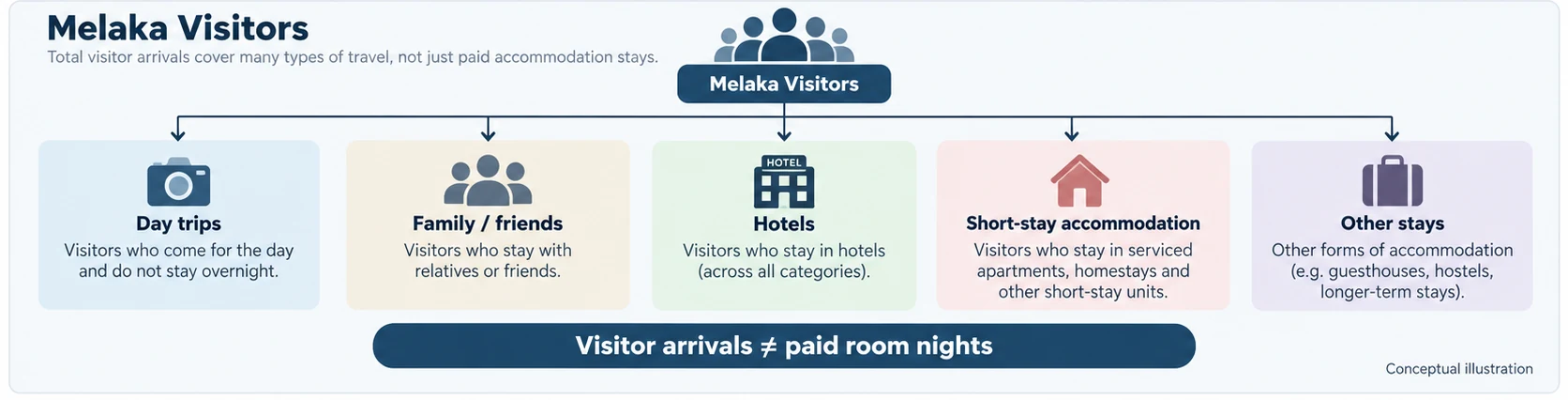
Tourism demand is real
This should be said clearly and without hedging. Melaka draws genuine, repeat, year-round visitor demand from within Malaysia and from Singapore and the wider region. Nobody serious argues otherwise, and any analysis that starts by doubting it is starting in the wrong place.
But statewide accommodation data do not prove scarcity
The problem is the step that usually follows. Buyers hear a large arrivals number and convert it, silently, into an assumption about occupancy. That conversion has no defensible ratio behind it. Arrivals include day-trippers who never book a room, visitors staying with family, and visitors staying in an entirely different part of the state.
The more relevant evidence is what paid accommodation in Melaka actually ran at. Public figures put 2024 statewide average occupancy at around 45.4%, with an average room rate of around RM167.10. For January to September 2025, occupancy was around 44.5% and the average room rate around RM150.40.
Those are statewide hotel-sector averages, not short-stay suite performance, and they should be read as a reference point rather than a proxy. But they do one important job: they do not demonstrate severe room scarcity. A market running in the mid-forties on occupancy is not a market where operators can name their price.
This is not the same as saying Melaka is oversupplied. The available data do not support that conclusion either. The honest position is narrower and more useful: occupancy at Tagbay has to be assumed, because it cannot be read off the market. And anything assumed should be tested at more than one level.
Why RevPAR matters more than ADR
Nightly rate on its own is a vanity number. The figure that matters is revenue per available room-night:
RevPAR = ADR times Occupancy
A unit advertising RM250 a night at 30% occupancy produces RM75 per available night. A unit at RM150 a night and 55% occupancy produces RM82.50. The second unit looks cheaper and earns more.
This matters at Tagbay specifically, because the location conversation later in this article is really a conversation about which of those two positions the building ends up in.
The Operating Economics: What the Numbers Have to Look Like
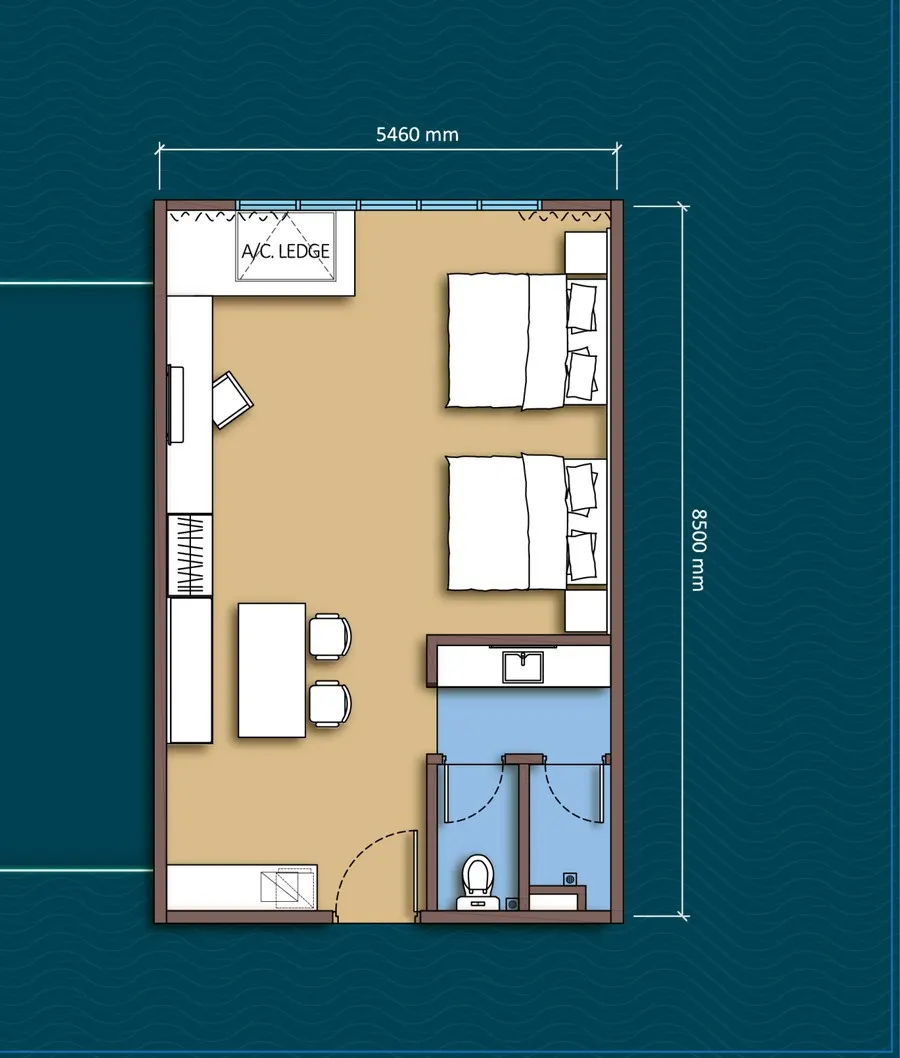
Illustrative only — assumptions stated, not a forecast.
Everything in this section is a worked illustration built on stated assumptions. None of it is a Tagbay projection, a developer estimate, or observed performance. Tagbay-specific ADR, occupancy and owner distributions are not publicly established.
Before the numbers, it is worth separating what is known from what is assumed from what is simply unconfirmed. Most disputes about projects like this come from mixing the three.
| Category | What falls into it |
|---|---|
| Known / public fact | 648 units in two towers on approximately 2.66 acres; 610 Standard Suites sharing the same 495 sqft layout, split between sea-view and city-view orientations; leasehold, commercial HDA title; maintenance RM0.32 psf inclusive of sinking fund; 324 car parks plus 13 OKU lots, not attached to units; completion 36 months after APDL; public headline price of RM332,300 for a 495 sqft Standard Suite; published Melaka statewide occupancy and room-rate figures |
| Illustrative model assumption | The 20% operator-side deduction used below; RM25 per occupied night for cleaning, linen and consumables; RM2,600 a year utilities and internet; RM1,200 a year assessment, quit rent and insurance; RM2,200 a year furniture and appliance reserve; every ADR and occupancy level tested |
| Unconfirmed Tagbay contract term | The actual operator fee and precisely what it covers; whether platform and channel commission sits inside or outside that fee; revenue pooling and booking allocation; pricing authority; owner opt-out; who bears furnishing capital expenditure; how car park bays are allocated; how sea-view and city-view units are priced relative to each other |
The cost assumptions used throughout
Applied to a 495 sqft Standard Suite, before financing and before tax:
- Operator side: 20% of gross room revenue. This is a model assumption drawn from a reference operating structure associated with the operator at a different project, not a Tagbay term. It is used here as a single combined deduction on the explicit basis that it already incorporates the distribution and platform-management layer — online travel listing and channel management, sales and marketing, CRM, IT systems, back-office and operational management. It is applied this way specifically to avoid double-counting distribution costs, which is the most common error in models of this kind. It is not a statement that Tagbay charges 20%, and it is not a statement that platform commission is absorbed by the operator at Tagbay. The final Tagbay contract must confirm the actual fee and the actual waterfall.
- Cleaning, linen and consumables: RM25 per occupied night (model assumption)
- Utilities and internet: approximately RM2,600 a year (model assumption)
- Maintenance and sinking fund: approximately RM1,900 a year, based on the published RM0.32 psf for a 495 sqft unit (published figure)
- Assessment, quit rent and insurance: approximately RM1,200 a year (model assumption)
- Furniture and appliance replacement reserve: approximately RM2,200 a year (model assumption)
Note that there is no separate platform or channel commission line. That is deliberate, and it is the single most important structural feature of this model. If Tagbay's eventual contract places platform commission outside the operator fee, every figure below overstates net income and must be reworked.
Substitute your own figures wherever you have better information. The structure of the calculation matters more than any single input.
Illustrative downside: RM150 ADR at 45% occupancy
These inputs are not a stress case. They sit close to the published Melaka statewide averages for January to September 2025. That is the point of choosing them.
Illustrative stronger case: RM180 ADR at 60% occupancy
Plausible, but unproven. This scenario requires the unit to run meaningfully above the statewide average on both rate and occupancy, at the same time, sustainably.
Revenue to NOI — both scenarios. Illustrative only — assumptions stated, not a forecast.
| Line | Scenario A (RM150 / 45%) | Scenario B (RM180 / 60%) |
|---|---|---|
| RevPAR | RM67.50 | RM108.00 |
| Occupied nights per year | ~164 | ~219 |
| Gross room revenue | RM24,638 | RM39,420 |
| Less operator side (20%, inclusive of distribution layer) | -RM4,928 | -RM7,884 |
| Less cleaning, linen, consumables | -RM4,106 | -RM5,475 |
| Less utilities and internet | -RM2,600 | -RM2,600 |
| Less maintenance and sinking fund | -RM1,900 | -RM1,900 |
| Less assessment, quit rent, insurance | -RM1,200 | -RM1,200 |
| Less furniture/appliance reserve | -RM2,200 | -RM2,200 |
| Net operating income | ~RM7,704 | ~RM18,161 |
| Net yield on RM332,300 public headline price | ~2.3% | ~5.5% |
These are net operating income before financing, before income tax, and before any allowance for the months during ramp-up when a new building is still building its booking history. Completion is 36 months after APDL, so there is a long period with costs of capital and no income at all.
The judgment from Scenario A: low entry alone does not save a genuinely weak operating outcome. Roughly 2.3% net, before financing, is a poor return for an asset carrying hospitality volatility, leasehold tenure and commercial title. It does not become acceptable because the purchase price was modest. This is the scenario that sits closest to current published statewide performance, which is precisely why it cannot be dismissed as pessimistic.
The judgment from Scenario B is different, and the difference matters. At roughly RM18,161 of net operating income, the model produces approximately 5.5% net yield before financing against the public headline price. That crosses the 5%-plus benchmark this article uses for an attractive net return.
That deserves to be stated plainly rather than buried, and it deserves to be qualified immediately. The unresolved issue is whether Tagbay can actually sustain that ADR and that occupancy, and whether its eventual operating-cost waterfall is as efficient as this illustrative model assumes. The 5.5% figure is an output of a model built on stated assumptions, one of which — the combined 20% operator-side deduction — is drawn from a reference structure rather than from Tagbay's own terms. It is not an expected Tagbay yield, and nothing here establishes that the building will reach it.
What the gap tells you
The two scenarios are separated by RM30 of nightly rate and 15 points of occupancy. That gap more than doubles net operating income, from roughly RM7,700 to roughly RM18,200, and moves the net yield from about 2.3% to about 5.5%. This is operating leverage, and it is the defining financial characteristic of the asset.
The reason is the fixed cost base. Maintenance, assessment, insurance, utilities and the furniture reserve total roughly RM7,900 a year whether the unit is busy or empty. Below a certain revenue level those fixed costs consume most of what the variable costs leave behind. Above it, incremental revenue drops through to NOI much faster.
Here is the same calculation across a grid, with net yield against the public headline price of RM332,300 shown in brackets.
Illustrative net operating income and net yield by ADR and occupancy. Illustrative only — assumptions stated, not a forecast.
| ADR / Occupancy | 45% | 50% | 55% | 60% |
|---|---|---|---|---|
| RM150 | RM7,704 (2.3%) | RM9,438 (2.8%) | RM11,171 (3.4%) | RM12,905 (3.9%) |
| RM165 | RM9,675 (2.9%) | RM11,628 (3.5%) | RM13,580 (4.1%) | RM15,533 (4.7%) |
| RM180 | RM11,646 (3.5%) | RM13,818 (4.2%) | RM15,989 (4.8%) | RM18,161 (5.5%) |
For reference, the 2024 Melaka statewide averages of roughly 45.4% occupancy and RM167.10 room rate sit very close to the 45% downside occupancy case in this grid, at an illustrative NOI of around RM10,500, or roughly 3.1% net on the public headline price. Again, that is a hotel-sector comparison rather than a short-stay benchmark, and a comparison is not a prediction.
What the grid shows is that this asset does not have a single answer. It has a range, and the range spans a factor of more than two across outcomes that are all individually ordinary. The top-right corner is a genuinely good result. The bottom-left corner is not. Neither is knowable in advance, and the distance between them is the actual risk in Tagbay.
It also shows where the sensitivity really lives. Moving down a column — that is, raising the rate by RM30 at constant occupancy — adds roughly 1.2 to 1.6 percentage points of net yield. Moving across a row from 45% to 60% occupancy at constant rate adds roughly 1.6 to 2.0 points. Occupancy is the harder variable to control and the more powerful one, which is why the demand and pricing-power sections above matter more than the brochure ever suggests.
It also means the grid is a building-level illustration rather than a single answer for every unit. Because the Standard Suite inventory includes both sea-view and city-view orientations, different units within the same layout may sit at different points on this grid.
Want this table run on your own assumptions?
Tell us your target yield and we can show you what purchase price it implies.
Run My Own NumbersLocation and Pricing Power: Kota Syahbandar / Klebang
Non-central does not mean no demand
The standard objection to Tagbay's location is that it is not in the historic core. That objection is only partially valid, and it is worth correcting properly.
A meaningful share of Melaka leisure demand is drive-based, particularly domestic and regional family travel. That makes non-central accommodation more viable than it would be in a city where tourists depend heavily on walking or public transport.
For these guests, parking, family-friendly space, easy driving access and a coastal setting can offset some of the disadvantage of not being in the historic core.
So the question is not whether guests will stay at Kota Syahbandar or Klebang. They demonstrably do. Non-central does not mean no demand.
There is, however, a project fact that deserves attention here. Tagbay has 324 car park bays plus 13 OKU lots across 648 units, and the car parks are not attached to units. That is a ratio of roughly one bay per two units. For a building whose likely guest base includes a significant drive-in segment, parking allocation is not a detail. It is an operational question that affects both guest experience and what the building can charge, and it is worth asking exactly how bays are allocated between owners, guests and visitors.
The real risk is pricing power
The real risk is pricing power, not whether guests will stay there at all.
The question is not whether people will stay there. It is what Tagbay can charge relative to central alternatives while maintaining occupancy.
This is where the arithmetic from the previous section does its work. If holding occupancy at a target level requires discounting RM20 or RM30 a night against central stock, that discount does not stay in the rate column. It flows through RevPAR into gross revenue, and then into NOI after the fixed cost base has taken its share. On the grid above, RM30 of ADR at a constant 55% occupancy is the difference between roughly RM11,200 and roughly RM16,000 of net operating income — about 3.4% net against about 4.8%.
A modest concession on rate is not a modest concession on return. It is close to a third of the return.
Sea view is a rate argument, not an occupancy guarantee
A sea-facing unit can reasonably command more than an inward-facing one, particularly at weekends and during holidays. That is a real and defensible advantage for the units that have it.
It is worth keeping the claim the right size. A view influences which unit a guest picks and what they will pay for it. It does not create the booking.
Within the Standard Suite inventory, view orientation also creates room-category segmentation rather than a completely uniform 610-unit pool. The core layout is highly standardised, but sea-view and city-view units are not fully interchangeable products, and that distinction gives the building more than one price point to work with. The size of any actual sea-view premium is not publicly established.
For a buyer, this cuts both ways. It means the unit you are being offered may not carry the same rate potential as the one used in a sales illustration, so it is worth establishing which orientation you are buying and how that orientation is positioned within the building's rate structure.
Operator and Inventory: Does Mana Mana Solve the Competition Problem?
Why many similar units are not automatically destructive
610 of Tagbay's 648 units share the same 495 sqft Standard Suite layout, but the inventory is not fully interchangeable, because sea-view and city-view units create different positioning and potentially different pricing power. The instinctive reaction to the headline number is that 610 comparable units will undercut each other into the ground.
That instinct describes a specific failure mode, and it is worth naming precisely. Destructive owner-versus-owner competition is a problem of fragmented pricing. It happens when hundreds of individuals list independently on the same platforms, watch each other's rates, and cut to fill their own calendar without regard to the building's overall revenue.
If pricing is set centrally, inventory is allocated centrally, and booking channels are unified, the building behaves much more like hotel inventory than like hundreds of competing listings. In that structure, 610 units on a common layout is a scale advantage rather than a liability. It supports better distribution, cheaper operations per unit, and coherent rate management.
The view segmentation adds to this. Sea-view and city-view segmentation gives the operator another pricing lever and can reduce direct one-to-one price competition between units if the inventory is managed centrally, in much the same way a hotel separates its room categories rather than selling one undifferentiated product. This creates the potential for pricing differentiation; it does not establish that any particular category achieves a premium.
So the number of comparable units is not, by itself, the problem. The structure that governs them is what matters.
What remains unconfirmed
Here the honest answer is that the structure is not publicly established. Specifically, the following remain unconfirmed on public information:
- whether revenue is pooled across units or accounted unit by unit
- how bookings are allocated between units of the same category
- how sea-view and city-view units are priced relative to each other
- who holds pricing authority, and whether it is exclusive
- whether an owner can opt out, and on what terms
- how inventory is managed across the two towers and across unit types
- the actual operator fee, and precisely which functions it covers
That last point is not a technicality. The entire operating model above turns on whether the distribution and channel-management layer sits inside the operator's scope or is charged to the owner separately on top. Those two structures produce materially different net income from identical gross revenue.
This is an open question, not an accusation. None of these arrangements is unusual or improper in either direction, and the absence of public detail does not imply anything adverse. But it is the most consequential unknown in this analysis, because it determines both whether the scale and segmentation work for owners and what the cost waterfall actually looks like.
These are questions to put in writing before committing, and to read the answers to in the actual documents rather than in a conversation.
Professional management reduces workload, not investment risk
Mana Mana is publicly identifiable as the hospitality operator associated with Tagbay, and operator involvement of this kind is a genuine positive on execution. It means standards are more likely to be consistent, listings more likely to be professionally managed, and the owner more likely to be spared the daily work of running a short-stay unit. For a foreign buyer or an out-of-state buyer, that is not a small thing.
It is still worth stating the limit plainly, because this is where most buyers stop thinking:
Professional management reduces workload, not investment risk.
Owner-level profitability at Tagbay is not publicly established. A capable operator improves the odds of the revenue side being executed well, and a well-designed fee structure can genuinely reduce total leakage compared with self-management. It does not set the market's occupancy, and it does not determine what you paid. Competence is an input. It is not a distribution.
Price vs Income: What "Cheap" Actually Means
Fair Purchase Price = Sustainable NOI divided by Target Net Yield
This is the formula that should govern the decision, and it runs in the opposite direction from how most buyers approach a launch.
Fair Purchase Price = Sustainable NOI / Target Net Yield
Instead of taking the asking price and hoping the income justifies it, you start with the income you believe the unit can sustainably produce, divide by the return you require, and arrive at the price you can rationally pay. Anything above that number is a decision to accept a lower return than you set out to earn.
Illustrative fair purchase price by sustainable NOI and target yield. Illustrative only — assumptions stated, not a forecast.
| Sustainable NOI (scenario) | At 4% target | At 5% target | At 6% target |
|---|---|---|---|
| RM7,704 (RM150 / 45%) | RM193,000 | RM154,000 | RM128,000 |
| RM11,171 (RM150 / 55%) | RM279,000 | RM223,000 | RM186,000 |
| RM13,580 (RM165 / 55%) | RM340,000 | RM272,000 | RM226,000 |
| RM13,818 (RM180 / 50%) | RM345,000 | RM276,000 | RM230,000 |
| RM15,989 (RM180 / 55%) | RM400,000 | RM320,000 | RM266,000 |
| RM18,161 (RM180 / 60%) | RM454,000 | RM363,000 | RM303,000 |
Read the 5% column against the public headline price of RM332,300. Only the top scenario in the grid justifies that price at a 5% target. The RM180 at 55% case comes close and falls slightly short. Everything below it implies a fair value under the headline price, and in the weaker cases substantially under it.
The table can also be read backwards, which is often more useful. Under the same illustrative assumptions, a unit acquired at RM332,300 needs roughly RM16,600 of net operating income to produce 5% net before financing. Working back through the cost stack, that implies something in the region of RM171 ADR at 60% occupancy, or about RM184 at 55%.
That result is worth sitting with, because it locates the risk precisely. An ADR around RM171 is close to the published Melaka statewide average room rate for 2024. The rate is not the stretch. Occupancy is. Sustaining 60% in a market whose published statewide average has been running in the mid-forties is the real assumption being made, and it is the one a buyer should interrogate hardest.
Cheap is not a low ticket price
Which brings us to the word the entire sales narrative rests on.
Cheap means the price is low enough that realistic, not exceptional, operating performance still produces an acceptable net return.
The corrected model does not say Tagbay is expensive. It says something more precise. At the headline price, the income case becomes defensible if the project reaches the strong end of the operating range. As performance moves toward the weaker scenarios, the price becomes increasingly difficult to justify on income alone.
It is worth being clear about what this framework does and does not measure. It values the income stream. It does not price resale liquidity, operator dependency, short-stay and strata-level regulatory risk, leasehold tenure, ramp-up, future refurbishment cycles, or execution risk generally. Those sit outside the formula and have to be judged separately, and each of them argues for requiring a wider margin rather than a narrower one.
The test is simple to apply. Take the middle of the grid, not the top. Run the fair-price formula. If the answer is comfortably above what you are being asked to pay, the price is doing the work and you have a margin of safety. If the answer only exceeds your price in the strong scenario, the operating performance is doing the work, and operating performance is the part nobody can promise you.
What counts as attractive?
A reasonable benchmark: 5% or more genuinely net yield, before financing, would be attractive if it is provable.
Three words in that sentence carry the weight. Genuinely means after the entire cost stack, not after the management fee alone. Net means net, which is the word most commonly stretched in this market. And before financing means the comparison is asset-level, so that a loan does not flatter or disguise the underlying return.
The illustrative strong scenario above clears that benchmark at roughly 5.5%. That is a statement about a model, not about Tagbay. It becomes a statement about Tagbay only if two things are established: that the building can sustain roughly RM180 ADR at roughly 60% occupancy on a durable basis, and that the eventual operating-cost waterfall is at least as efficient as the combined 20% operator-side assumption used here. Neither is established by anything in the public record, and this article does not claim that either is true.
The most common failure in assessing a project like this is accepting a yield figure without asking what it is net of. Ask for the deduction list. If a number is quoted without one, it is a gross figure wearing a net label.
Effective acquisition cost
"The investment case may strengthen materially if the buyer's effective acquisition cost is below the public headline price, but buyer-specific packages are not discussed here."
Frequently Asked Questions
Is Tagbay Suites a good investment?
That depends on two numbers: the income the unit can sustainably produce, and your effective acquisition cost. Tagbay should be assessed as a hospitality business rather than as a condo, which means net operating income after the full cost stack is the relevant figure, not gross rental yield. Under the illustrative model in this article, outcomes range from roughly 2.3% net at RM150 ADR and 45% occupancy to roughly 5.5% net at RM180 and 60%, measured against the public headline price of RM332,300 and before financing. That spread is the answer: the project is defensible at the strong end of the range and poor at the weak end, and the deciding variable is operating performance that nobody has yet demonstrated. Run the fair-price formula using a mid-range assumption rather than the best one.
What is a realistic rental yield for a Melaka short-stay suite?
There is no single honest answer, and anyone offering one without stating assumptions is guessing. What can be said is that the calculation must run through RevPAR rather than nightly rate, and then through the full cost stack. How much that stack absorbs depends heavily on structure: where distribution and channel management sit inside a professional operator's scope, the total leakage is lower than a self-managed model with separate platform commission on top, and confusing the two produces badly wrong numbers in either direction. Public Melaka statewide figures put 2024 occupancy at around 45.4% with an average room rate around RM167.10, and January to September 2025 at around 44.5% and RM150.40. Those are hotel-sector references rather than short-stay benchmarks, but they are a reasonable reality check against optimistic assumptions. A yield of 5% or more that is genuinely net and before financing would be attractive, if it can be proved.
Does Mana Mana guarantee my returns?
This article does not discuss any specific commercial arrangements, and the conceptual answer is the one that matters. Professional hospitality management reduces the owner's workload and improves the likelihood that operations are executed competently, and a bundled operating scope can reduce total cost leakage relative to self-management. It does not, by itself, establish owner profitability. An operator influences the revenue side and the cost side; it does not set the market's occupancy level or change what you paid for the unit. Whatever arrangement is presented to you, read the actual document and establish exactly what is committed, what the fee covers, for how long, and by whom.
Will so many similar units compete with each other?
Not necessarily, and this is more nuanced than it first appears. 610 of the 648 units share the same 495 sqft Standard Suite layout, so the core product is highly standardised, and the risk people imagine is owners undercutting each other to fill their own calendars. Two things soften that. First, the inventory is not fully homogeneous: sea-view and city-view orientations create natural room-category differentiation within those 610 units, which gives the building more than one price point and reduces the degree of pure one-to-one substitution between listings. The size of any actual view premium is not publicly established. Second, and more importantly, that failure mode comes from fragmented pricing, where individuals list independently against one another. If pricing, inventory allocation and booking channels are managed centrally, the building behaves closer to hotel inventory, and the scale becomes an advantage in distribution and operating cost. Operator pricing, allocation and booking structure matter considerably more than the unit count, and Tagbay's actual arrangements are not confirmed in public information. That is the question to get answered in writing before you decide.
Sources
- Tagbay Suites — official developer brochure (Taghill Land Sdn. Bhd.) - Project facts only: 648 units in two towers on approximately 2.66 acres, 610 Standard Suites at 495 sqft, leasehold, commercial HDA title, maintenance RM0.32 psf inclusive of sinking fund, 324 car parks plus 13 OKU lots not attached to units, completion 36 months after APDL. Supports no ADR, occupancy, yield or owner-distribution claim.
- Tourism Malaysia — Paid Accommodation Survey / KPI 2024 - 2024 Melaka statewide paid-accommodation AOR 45.4% and ARR RM167.10, used only as a market reference point for the illustrative model. Supports no Tagbay-specific ADR, occupancy or performance claim.
- Tourism Malaysia — Paid Accommodation Survey Performance Jan-Sep 2025 - January-September 2025 Melaka statewide paid-accommodation AOR 44.5% and ARR RM150.40, used only as a market reference point for the illustrative model. Supports no Tagbay-specific ADR, occupancy or performance claim.
- AskHenry project record — Tagbay Suites - Public headline pricing (from RM332,300 for a 495 sqft Standard Suite), developer, tenure, unit count and maintenance rate as published on this site. Supports the public headline price used throughout the model; supports no buyer-specific pricing of any kind.